
Most lace wig buying guides are written by people who’ve never set foot in a wig factory. They tell you to “look for quality hair” and “buy from a trusted brand” without telling you what quality actually looks like or which signals to trust.
Our team is different. We work directly with the factories that produce these units. We’ve watched what gets shipped as “premium” vs. what gets shipped as “budget,” and we know exactly where corners get cut. This guide is the checklist we’d give a close friend before her first lace wig purchase — straight, honest, and based on what really matters.
If you read this all the way through, you’ll know more about evaluating a lace wig than 90% of buyers walking into this market.
Before You Shop: Know What You Actually Need
Before evaluating any product, get clear on what you want. This prevents you from being swayed by marketing.
| Question | Beginner Default |
|---|---|
| Construction | 13×4 lace front |
| Lace material | Transparent (or HD if budget allows + deeper skin) |
| Hair material | Human hair Remy |
| Density | 150-180% |
| Length | 16-18 inches |
| Texture | Body wave or straight |
| Install method | Glueless |
| Budget | $200-$350 |
If you go in knowing these answers, you’ll filter out 80% of options instantly and only evaluate the ones that match your needs.
The Factory Insider’s Checklist — 12 Quality Markers
Now the substance. Here are the 12 things our factory team would check on any unit before recommending it to a friend.
1.Is It Real Remy Hair?
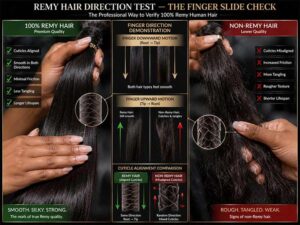
This is the single most important quality marker, and the one most often misrepresented. Remy hair has all cuticles aligned in the same direction (root to tip), preventing tangling. Non-Remy hair has been acid-stripped of its cuticles and silicone-coated to fake smoothness — it tangles severely after 3-4 washes.
How to verify: Ask the seller directly, “Is this Remy or non-Remy?” Honest sellers say “Remy.” Evasive answers (“Remy-quality,” “processed to Remy standard”) usually mean non-Remy. Below ~$120 for a full wig, assume non-Remy unless explicitly proven otherwise.
2.Real Customer Photos, Not Stock
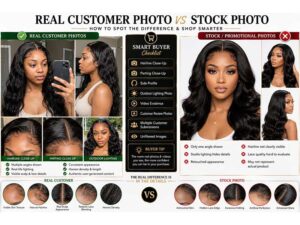
Factory stock photos always look perfect. Real customer photos show how the wig actually behaves in real lighting, real install conditions, and real Black skin tones.
How to verify: Look for the brand’s tagged photos on Instagram and TikTok, customer reviews with photos, and unboxing videos. If the only images are professionally lit studio shots, you’re seeing the best-case scenario. Real customer content tells you the worst-case.
3.Honest Lace Specs (Not Just “HD Lace”)
“HD lace” is the most-faked label in the industry. Real HD lace cannot be produced at low price points — the math doesn’t work (see Blog #4 for the full breakdown).
How to verify: Ask for the denier or thread count if the brand will share it. Lower denier (under 40) means thinner, more invisible lace. A brand that publishes specs is usually offering a genuinely better product. If “HD lace” is sold for under $150 for a full wig, expect transparent lace marketed as HD.
4.Clear Return and Refund Policy
Quality brands stand behind their product. Sketchy brands hide their return policies or make returns nearly impossible.
How to verify: Find the return policy before buying. Look for clear terms: how long you have, what condition the wig must be in, who pays shipping, whether the lace can be cut and still returned. “All sales final” or unclear policies are red flags. Reputable brands typically allow returns of uncut, uninstalled wigs within 7-14 days.
5.Responsive Customer Service Pre-Purchase
How a brand answers your questions before you buy is how they’ll treat you if there’s a problem after.
How to verify: Send a real question — “Is this Remy?” or “What’s the lace denier?” or “What’s your return policy?” — and see how they respond. Speed, clarity, and willingness to share specifics signal a legitimate operation. Generic copy-paste replies or evasive answers signal trouble ahead.
6.Realistic Pricing
Pricing tells you almost everything about what’s inside.
Reliable price floors for honestly-labeled wigs:
- Real human hair Remy lace front, 13×4: $150 minimum
- True HD lace + human hair Remy: $250 minimum
- Virgin Remy single-donor: $300 minimum
- Full lace human hair: $400 minimum
Below these prices, something is being downgraded or mislabeled. There are no real exceptions — these are based on actual manufacturing costs, not marketing.
7.Density Within Natural Range (150-180%)
Wigs sold at 200%+ density look obviously thick and “wig-like” for everyday wear. 150% is the most natural; 180% is the popular middle ground for Black women wanting fullness. (See Blog #20 for the density guide.)
How to verify: Density should be listed in the product specs. If the brand doesn’t disclose density, that itself is a warning sign — it suggests they’re not paying attention to the details that matter.
8.The Pre-Pluck Quality (If Pre-Plucked)
Pre-plucked wigs vary wildly in quality. A good pre-pluck is uneven — denser in some areas, sparser in others, mimicking how real hair grows. A bad pre-pluck just aggressively thins the front uniformly, which looks sparse and unnatural.
How to verify: Look closely at the hairline density photos on the product page. If the hairline looks perfectly uniform across the entire front, the pre-pluck wasn’t done with skill. If it has subtle variation, you’re looking at quality work.
9.Cap Quality and Adjustability
The cap matters as much as the hair. Look for: adjustable elastic straps, sewn-in combs, a breathable cap material, and (ideally) an inner ear-tab strap.
How to verify: Many product pages don’t show the cap. Ask the seller for a photo of the inside of the cap. A quality cap looks neat and well-finished; a cheap cap has loose threads, uneven seams, or rough material.
10.Texture That Matches Your Lifestyle
The texture of the wig affects how much daily maintenance it needs. Body wave and straight are most forgiving for beginners. Kinky and deep curly need more product knowledge and more maintenance.
How to verify: Be honest with yourself about how much time you’ll spend on maintenance. A high-maintenance texture looks beautiful but will get neglected if you don’t have time, then look worse than a simple texture you actually care for.
11.The Seller’s Multi-Platform Presence
Legitimate brands have a consistent presence across multiple platforms — website, Instagram, TikTok, sometimes YouTube. Sketchy operations exist on only one channel, often a single Instagram with limited history.
How to verify: Search the brand name. Do they have a real website with full policies, an active Instagram with tagged customer photos, and TikTok or YouTube content? Or are they a single Instagram account with five posts? The depth of presence matters.
12.Willingness to Share Hair Sourcing
Brands that ethically source their hair are usually willing to talk about it. Brands that are evasive about sourcing usually have something to hide.
How to verify: Ask, “Where is your hair sourced?” Look for specific answers (“Indian temple hair,” “Vietnamese rural collection”) rather than vague labels (“100% Brazilian”). See Blog #8 for the full story on what hair labels actually mean.
Red Flags to Walk Away From
If you spot any of these, our team would say move on:
- “100% virgin Remy Brazilian HD lace” under $100 — impossible at that price
- No customer photos anywhere — only stock images
- “All sales final” or hidden return policies
- No specs listed — no density, no lace dimensions, no length confirmation
- Slow or generic customer service replies
- Single-platform presence with limited history
- Reviews that all sound the same (fake reviews)
- Aggressive countdown timers or “only 2 left” pressure
- Refusal to answer Remy/non-Remy or sourcing questions
- Photos copied from other brands (reverse-image search if suspicious)
Green Flags to Look For
The signs of a legitimate, quality-focused brand:
- Real customer photos in tagged Instagram content
- Published specs (density, lace dimensions, hair type, length)
- Clear, accessible return policy
- Responsive, specific customer service
- Honest about what their hair is and isn’t (Remy, virgin, source)
- Consistent multi-platform presence with months/years of history
- Reviews that vary in tone and detail (real reviews aren’t all 5 stars)
- Realistic pricing that aligns with the material claims
- Willingness to send additional photos pre-purchase
- Educational content (not just sales)
How to Test the Wig When It Arrives
Once you have the unit, test it before you cut or install. These checks let you return it if it’s not what was promised:
- Hold the lace up to bright light. HD lace = nearly invisible. Transparent lace = visible mesh.
- Run a finger up the hair against the growth direction. Should feel slightly rough (Remy). If it feels smooth in both directions, the cuticles have been stripped (non-Remy).
- Smell the hair. Real Remy human hair has little to no smell. A strong chemical or burning smell indicates heavy processing or non-Remy.
- Check the construction. Examine the cap, seams, ear tabs, and ventilation. Should look neat and consistent.
- Measure the length. Real wig length is measured straight, not at the curl. Make sure it matches what was advertised.
- Confirm density looks right. Compare to the product page photos.
- Do the three-wash test if you can afford to. Real Remy hair survives three washes; non-Remy mats and tangles. Worth doing before cutting if quality is uncertain.
The Beginner-Friendly First Wig Profile
If you remember nothing else from this guide, here’s the safest first purchase:
OUR TEAM’S BEGINNER RECOMMENDATION13×4 transparent lace front, 150-180% density, 16-18 inches, body wave or straight, human hair Remy, glueless install ready, $200-$350 from a brand with real customer photos, clear returns, responsive customer service, and a multi-platform presence.
This combination minimizes risk while giving you a unit that’s truly representative of a quality lace wig. Once you’ve worn this and know what you like, you can confidently upgrade to HD lace, 13×6, or full lace for your next purchase.
Frequently Asked Questions
What’s the most important thing to check before buying a lace wig?
Whether it’s Remy hair. Non-Remy human hair looks gorgeous on day one but mats and tangles within 3-4 washes because the cuticles have been chemically stripped. Real Remy is the single biggest quality marker, more important than the country label or the lace type.
How much should a first lace wig cost?
$200-$350 for a quality human hair Remy lace front. Below $150 you’re likely getting synthetic, non-Remy, or very low-grade hair that won’t last. Above $500 is premium territory not necessary for a beginner. The $200-$350 range gives you a genuinely good unit without overspending while you learn.
How can I tell if a lace wig is fake before buying?
Use the price test: if it’s advertised as “virgin Remy human hair HD lace” for under $100, the math is impossible — something is being downgraded or mislabeled. Look for real customer photos (not just stock), published specs, clear return policies, and willingness from the seller to answer specific questions about Remy status and hair sourcing.
Is HD lace worth it for a first wig?
For most beginners, no. Transparent lace is more durable, more forgiving during install, and significantly cheaper. HD lace is fragile and tears easily under rough handling — risk you don’t want on your learning wig. Upgrade to HD on your second or third unit once you’ve built install skills. The exception: if you have deep skin tone and want minimal tinting work, pre-tinted HD lace is worth the upgrade upfront.
Should I buy from Amazon, Aliexpress, or a dedicated wig brand?
Dedicated wig brands generally offer better quality control, customer service, and returns than marketplaces. Marketplaces (especially Aliexpress) have huge variance — you can find quality units and absolute junk on the same site. For a first wig, our team’s recommendation is a dedicated brand with a multi-platform presence and clear policies. Once you know what quality feels like, you can evaluate marketplace options more confidently.
What’s the safest length for a first lace wig?
16-18 inches. Long enough to look full and feminine, short enough to be manageable, less prone to tangling, easier to detangle and wash. Longer units (24+ inches) look beautiful but require more daily care and shorter wig life if neglected.
How do I know if a seller is legitimate?
Check: real customer photos in tagged Instagram content, consistent multi-platform presence (website + IG + TikTok), responsive customer service that answers specific questions, clear return policies, and reviews that vary in tone (not all identical 5-stars). The depth of online presence and willingness to communicate matter more than slick marketing.
Can I return a lace wig if I don’t like it?
Depends on the brand’s policy. Reputable brands typically allow returns of uncut, uninstalled wigs within 7-14 days. Once you cut the lace or install the wig, most brands consider it non-returnable. Always check the return policy before buying, and don’t cut anything until you’re sure you want to keep it.
Continue Learning
- [Internal link to Blog #1] The Complete Guide to Lace Wigs
- [Internal link to Blog #2] Lace Wig Types Explained
- [Internal link to Blog #4] HD Lace vs Transparent Lace
- [Internal link to Blog #8] Brazilian vs Peruvian vs Indian Hair
- [Internal link to Blog #20] Lace Wig Density Guide: 130%, 150%, 180%