
Publié: Peut 2026 | Dernière mise à jour: Peut 2026 Temps de lecture: 16 minutes
If you’ve ever scrolled through Instagram or TikTok and wondered how someone’s hairline looks that flawless, chances are you were looking at a lace wig. Lace wigs have completely changed the way Black women wear, switch, and protect their hair — but the world of lace can also feel overwhelming when you’re just starting out.
dentelle HD, dentelle transparente, 13×4, 13×6, glueless, bleached knots, plucked hairlines — the terminology alone can stop a beginner in her tracks.
By the end of this guide, you’ll understand:
- What a lace wig actually is — and what isn’t really a lace wig
- Every major type of lace and how they differ in look, feel, and price
- How to choose the right lace wig for your lifestyle, skin tone, and budget
- What manufacturers don’t always tell you about pricing, quality, and hair sourcing
- How to install, care for, and extend the life of your unit
Let’s get into it.
Réponse rapide:
A lace wig is a wig made with sheer lace at the hairline or cap, with hair strands tied into the lace to create the look of hair growing from the scalp. Pour la plupart des débutants, a 13×4 or 13×6 lace front wig in 150% density is the easiest starting point because it offers a natural hairline, flexible parting, and a more manageable price than full lace wigs.
Qu'est-ce qu'une perruque en dentelle?
A lace wig is a wig built on a sheer lace base, with individual strands of hair tied — or “ventilated” — into the lace by hand. When the lace sits against your skin, it disappears. The illusion is that the hair is growing directly out of your scalp.
That’s the whole point. Unlike traditional wigs that sit obviously on top of your head, lace wigs give you a natural-looking hairline you can part anywhere, style any way, and pull into a ponytail without showing tracks, coutures, or a hard wig line.
Three things make a lace wig different from a regular wig:
- The base material. Lace wigs use sheer Swiss, Français, HD, or transparent lace — engineered to mimic scalp.
- Hand-tied construction. Each strand of hair is knotted into the lace one at a time, allowing the hair to move and part naturally in any direction.
- The hairline. The lace extends past where the hair begins, giving you a customizable, blendable hairline that disappears against your skin.
Why Lace Wigs Are So Popular Among Black Women
Lace wigs aren’t just a trend in our community — for many Black women, they’re a daily styling tool, a protective style, and a confidence builder all in one. Our team has watched this category grow from a niche celebrity product into a mainstream essential, and the reasons are clear:
They protect natural hair. Constant heat styling, manipulation, and chemical processing damage type 3 et 4 hair textures. A lace wig lets you switch up your look without touching your real hair underneath — which means you can grow length and retain edges while still showing up however you want.
They mimic scalp across the full range of Black skin tones. This is the part that’s often misunderstood. Old-style lace wigs were originally designed for lighter complexions and looked obvious on darker skin. Modern HD and transparent lace, when properly bleached and tinted, blends seamlessly from light caramel to the deepest ebony tones. The technology genuinely caught up.
They allow versatility most styles can’t match. A high ponytail, a deep side part, baby hairs laid down, a sleek low bun — all impossible with a traditional cap wig, all possible with a quality lace unit.
They save time. Once a lace wig is installed, getting ready can take 5 minutes. No flat-ironing edges, no twist-outs going sideways, no last-minute scrambling before work or a wedding.
That combination — protection, versatility, and a flawless look — is hard to find anywhere else. And it’s why lace wigs went from a luxury item for celebrities and stage performers to something the average woman wears on a Tuesday.
Le Different Types of Lace, Explained
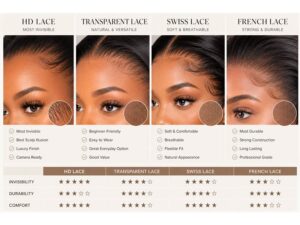
This is where most beginners get lost. “Dentelle” isn’t one material — it’s a whole family of materials, and the differences matter. Here’s what each type actually means, straight from our production floor:
Dentelle HD (Haute définition)
dentelle HD is the thinnest and finest lace currently in mass production. It’s almost invisible against the skin and needs only minimal tinting to match deeper complexions.
- Idéal pour: natural-looking hairlines, photoshoots, occasions spéciales
- Avantages: virtually invisible, doux, comfortable, photographs beautifully
- Inconvénients: delicate (tears easily if you pluck too aggressively), plus cher, shorter lifespan when handled roughly
Dentelle transparente
Transparent lace is a clear, lightweight lace that comes from the factory pre-tinted to a very light beige. It’s more durable than HD lace and works well for medium to light skin tones, though darker complexions usually need to tint it down with foundation or fabric dye.
- Idéal pour: everyday wear, débutants, lighter to medium skin tones
- Avantages: more durable than HD, easier to install, budget-friendly
- Inconvénients: needs tinting on darker skin, slightly more visible than HD
Dentelle Suisse
Swiss lace is the traditional gold standard — soft, undetectable, made with finer threads than standard French lace. It’s been used in high-end wig making for decades.
- Idéal pour: tenue à long terme, premium custom units
- Avantages: natural look, soft against skin, gentle on the scalp
- Inconvénients: fragile, expensive, mostly used in custom and luxury units
Dentelle française
French lace is sturdier and more durable than Swiss lace, but slightly more visible. Most affordable mid-range lace wigs use French lace because it holds up well to repeated installs and washes.
- Idéal pour: everyday wear, beginners who want durability
- Avantages: durable, abordable, easy to work with
- Inconvénients: less invisible than HD or Swiss
Lace Wig Styles: Front, Complet, 360 and Closure
Beyond the lace material itself, lace wigs come in different construction styles. Each style determines how much of the wig is hand-tied lace versus machine-wefted hair — and that affects both price and styling versatility.
| Style | Lace Coverage | Idéal pour | Prix typique |
|---|---|---|---|
| Lace Closure Wig | 4×4 or 5×5 inches at the top | Budget option, middle-part styles only | $60–$200 |
| Lace Frontal Wig | 13×4 or 13×6 across the front | Most popular — versatile parting | $120–$400 |
| 360 Lace Wig | Full perimeter (front + back) | Ponytails, updos | $200–$500 |
| Full Lace Wig | Entire cap is lace | Maximum versatility, premium feel | $300–$1,000+ |
In our experience working , most Black women starting out do best with a 13×4 or 13×6 lace front wig. It gives you the versatility to part anywhere across the front, without the price tag — or fragility — of a full lace unit.
Human Hair vs. Synthetic Lace Wigs
Almost every lace wig falls into one of two categories: human hair or synthetic. The difference goes well beyond price — it affects how the wig looks, how long it lasts, and what you can do with it.
Human Hair Lace Wigs
Made from real human hair sourced (in most cases) from India, parts of Southeast Asia, Chine, or Eastern Europe. The hair can be colored, heat-styled, washed, and treated just like your own — because it est real hair.
- Lifespan: 1 à 3 années avec des soins appropriés
- Regarder: indistinguishable from natural hair
- Prix: $150 à $1,000+
Synthetic Lace Wigs
Made from man-made fibers like Kanekalon or Toyokalon. They come pre-styled and hold their shape well, but most cannot be heat-styled with regular tools (heat-resistant fibers exist but are limited in what they can handle).
- Lifespan: 3 à 6 mois
- Regarder: improving every year, but still gives a slight “shine” in direct sunlight
- Prix: $40 à $150
Lace Wig Density: 130%, 150%, 180% Explained
Densité refers to how much hair is attached to the lace cap — basically, how thick the wig looks and feels. It’s expressed as a percentage of the density of a full, natural head of hair.
| Densité | Regarder | Idéal pour |
|---|---|---|
| 130% | Lumière, naturel | Older clients, those who naturally have fine hair |
| 150% | Moyen, tous les jours | Most beginners — looks natural without being too thick |
| 180% | Complet, glamour | Black women who want classic full-body styles |
| 200%+ | Très épais | Représentation sur scène, costume, regards dramatiques |
How to Choose Your First Lace Wig
If you’ve never bought a lace wig before, the choices can feel paralyzing. Here’s the framework first-time buyers through:
Step 1: Decide your budget honestly
A real, decent-quality human hair lace front wig starts around $150–$200. Anything below that is either synthetic, non-Rémy, or has very small lace coverage. We don’t expect a $50 wig to look like a $300 one — the materials and labor cost simply prevent it.
Step 2: Pick the right lace style
Pour 90% of beginners, we recommendation is a 13×4 HD or transparent lace front in 150% ou 180% densité. It’s versatile, affordable enough to learn on, and forgiving while you build install skills.
Step 3: Match the lace to your skin tone
- Light to medium skin: transparent lace works straight out of the box
- Medium to deep skin: dentelle HD, or transparent lace tinted with foundation, BB cream, or fabric dye
- Deep to ebony skin: HD lace tinted darker, or order a pre-tinted unit if the brand offers one
Step 4: Pick your length and texture
First-time wearers do best with 16 à 20 inch units. Anything longer is harder to manage, tangles faster, and shows neglect sooner. For texture, our team recommends body wave or straight for beginners — they’re the most forgiving. Kinky and deep curly textures require more product knowledge to maintain over time.
Step 5: Check the seller’s credibility
- Real customer photos (not just brand stock photos)
- Clear refund and return policy
- Responsive customer service before you buy (test it)
- Consistent presence across multiple platforms — website, Instagram, Tik Tok
How a Lace Wig Is Installed (Quick Overview)
We cover full installation in a separate, in-depth guide, but here’s the short version so you know what you’re getting into:
- Prep your natural hair — braid it down flat or use a wig cap
- Cleanse and dry your hairline with alcohol or skin protectant
- Cut the excess lace, leaving a hairline-shaped edge
- Place the wig and secure it with adhesive (colle à dentelle, got2b, or Got2B Glued spray) or an elastic band if you’re going glueless
- Lay your edges with the baby hairs in the front
- Tint the lace if needed with foundation that matches your skin
- Style
Glueless installs have become extremely popular because they’re gentler on your edges and don’t require adhesive on your skin. If you’re new to lace wigs, our team strongly recommends starting glueless. Your hairline will thank you in five years.
How to Care for Your Lace Wig
A human hair lace wig that’s cared for properly can last 1 à 3 années. A lace wig that gets thrown in a drawer at night will last 3 mois. Le care routine matters as much as the unit itself.
The basics:
- Wash every 7-10 wears, or whenever buildup is visible. Use sulfate-free shampoo and a deep conditioner.
- Detangle gently, starting from the ends and working up. Wide-tooth comb only.
- Air-dry on a wig stand. Heat from blow dryers shortens lifespan dramatically.
- Use heat protectant before any styling tool.
- Store on a mannequin head, not balled up. This keeps the style intact between wears.
- Sleep on satin or take the wig off at night. Cotton pillowcases wreck both the wig and your edges.
Common Mistakes Beginners Make
If you can avoid these six, you’re already ahead:
- Buying based on price alone. UN $40 “human hair lace front” on a marketplace is going to disappoint you. Our team would rather see you save up and buy one good unit than burn through five bad ones.
- Skipping the lace tint. Even “HD” lace usually needs a light tint for darker complexions. Untinted lace looks gray against deep skin.
- Over-plucking the hairline. Once you’ve plucked too much, you can’t undo it. Start sparse and add more density removal gradually.
- Using too much glue. More adhesive doesn’t equal a longer hold — it equals itchiness, breakouts, and a unit that’s painful to remove.
- Cutting the lace before placing the wig. Always position and pin the wig first, then cut along your natural hairline.
- Wearing the same wig 24/7 with no breaks. Your scalp and edges need rest. Take the wig off at night.
How Long Should a Lace Wig Last?
With proper care, here’s what our team sees in practice:
- Synthetic lace wig: 3 à 6 mois
- Mid-range human hair (non-Rémy, $150-$300): 6 à 12 mois
- Premium Remy human hair ($300-$700): 1 à 2 années
- High-end virgin Remy or custom unit ($700+): 2 à 3+ années
These numbers assume the wig is being worn 3-5 times a week, washed every 7-10 wears, and stored properly. If you wear daily and wash less often, the upper end of these ranges drops by roughly half.
Final Word
Lace wigs aren’t going anywhere. If anything, they’re getting more accessible, more natural, and more diverse every year — better lace materials, more ethical hair sourcing, better fit across a wider range of head shapes and complexions.
If you take one thing away from this guide: don’t be in a hurry. The biggest mistake we sees from new lace wig wearers is buying the cheapest unit they can find, getting frustrated when it doesn’t look like the influencer’s, and writing off lace wigs entirely. The right unit, installed properly and cared for well, will genuinely change the way you think about hair.
And remember — the goal isn’t perfection. The goal is finding a unit that fits your life. Some of us want stage-ready glam every day. Some of us want a simple bun we can throw up and go. Both are valid, and both are why this category exists.
Foire aux questions
Are lace wigs damaging to natural hair?
Not when worn correctly. In fact, lace wigs are one of the best protective styles available — they let your natural hair rest from heat, manipulation, et style. The damage usually comes from the install, not the wig itself: too-tight braids underneath, harsh adhesives on the hairline, or wearing the wig for weeks without taking it off.
Can I dye a human hair lace wig?
Oui, but proceed carefully. Most pre-made human hair lace wigs have already been color-processed at the factory. Adding more color (especially bleach) can damage hair that’s already gone through one or two chemical processes. If you want a specific color, our team’s recommendation is to buy a wig already in that color rather than try to lift a dark one yourself.
How do I make a lace wig look more natural?
Three things matter most: (1) teintez la dentelle pour qu'elle corresponde à votre peau, (2) pluck the hairline lightly so the density mimics natural hair growth, (3) lay your baby hairs in a realistic pattern, not a perfect symmetrical swirl. We have a separate guide that walks through all 12 pro tips for a natural look.
Why does my lace wig look fake on me?
Usually one of four reasons: dentelle non teintée, over-plucked or under-plucked hairline, wrong density for your face shape, or installation issues at the temples. We have a full troubleshooting guide for this — link to come.
What’s the difference between a lace front and a full lace wig?
A lace front has hand-tied lace only across the front hairline (typically 13×4 or 13×6 inches), with the rest of the cap being machine-wefted hair. A full lace wig has hand-tied lace covering the entire cap, allowing you to part anywhere — including high ponytails and updos. Full lace costs significantly more and is more delicate, but offers maximum styling versatility.
How much should I spend on my first lace wig?
In our experience, $200 à $350 is the sweet spot for a first human hair lace front wig that will actually look good. Ci-dessous $150 you’re either getting synthetic or low-grade non-Remy hair that will tangle within weeks. Au-dessus de $500 is premium territory and not necessary for a first purchase.
Continuer l'apprentissage
This guide gives you the foundation. If you want to go deeper, these related LaceWig guides can help you choose, install, and care for your first unit with more confidence.
- Qu'est-ce qu'une perruque en dentelle? Un guide adapté aux débutants
- Types de perruques en dentelle expliqués: HD, Transparent, suisse, Français & Plus
- Dentelle HD vs dentelle transparente: Lequel disparaît réellement sur votre peau?
- Lace Front vs Full Lace vs 360 Dentelle: Comparaison complète
- 13×4 vs 13×6 vs 5×5 Lace Closure: Size Guide
- Guide de densité de perruque en dentelle: 130%, 150%, 180%
- Que rechercher lors de l’achat de votre première perruque en dentelle
- Comment installer une perruque en dentelle: Guide étape par étape
- Comment laver une perruque en dentelle sans l'abîmer
- Comment donner à une perruque un aspect naturel: 12 Conseils de pro