
Si vous avez acheté une perruque en dentelle au cours des deux dernières années, tu as vu le débat partout: Dentelle HD versus dentelle transparente. Chaque marque propose sa version comme “le plus invisible.” Chaque tutoriel TikTok ne jure que par l'un ou l'autre. Les prix varient de $80 à $800, et les étiquettes ne correspondent souvent pas à ce que vous recevez réellement.
Alors, lequel disparaît vraiment sur votre peau?
Ce guide détaille toutes les différences qui comptent - des fils eux-mêmes à leur apparence sur différents teints sous différents éclairages..
dentelle HD est le plus mince, la dentelle la plus invisible actuellement produite en série — elle disparaît sur la peau avec une teinte minimale, mais c'est délicat et coûte cher 30-50% plus que de la dentelle transparente. Dentelle transparente est plus durable et adapté aux débutants, mais il est légèrement visible de près et doit presque toujours être teinté sur une peau moyenne à foncée. Pour les femmes noires au teint plus foncé ou qui tournent du contenu, La dentelle HD vaut la mise à niveau. Pour les porteurs de tous les jours et les débutants, la dentelle transparente est l'achat le plus intelligent.
Que sont réellement la dentelle HD et la dentelle transparente
Les noms se ressemblent suffisamment pour que la plupart des acheteurs supposent qu’il s’agit presque de la même chose avec des stratégies marketing différentes.. Ils ne le sont pas.
dentelle HD (Haute définition)
La dentelle HD est une maille ultra fine en nylon ou en polyester, généralement tissé à 30 denier ou plus fin. Les fils eux-mêmes sont si fins que lorsque la dentelle est tendue contre la peau, le maillage devient presque imperceptible, tant visuellement qu'au toucher. La dentelle HD a été développée spécifiquement pour résoudre le “racine des cheveux visible” problème qui tourmentait les anciennes perruques en dentelle.
Dentelle transparente
La dentelle transparente utilise des matériaux similaires mais avec des fils plus épais (typiquement 40-50 denier) et un tissage légèrement plus serré. Il vient de l'usine pré-teinté dans une couleur beige clair, conçu pour disparaître sur les teints plus clairs. Le maillage est visible de près mais se fond bien à bout de bras, surtout sur les peaux plus claires.
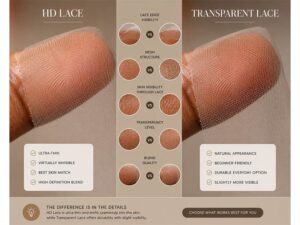
La différence visuelle: Ce que vous verrez réellement
Les allégations marketing mises à part, voici à quoi ressemblent la dentelle HD et la dentelle transparente dans des conditions réelles:
Sur les peaux claires à moyennes
Les deux types de dentelle fonctionnent bien. La dentelle transparente pré-teintée en usine s'adapte aux teints plus clairs dès la sortie de la boîte.. La dentelle HD est légèrement plus invisible, mais la différence est subtile - peut-être un 10-15% amélioration.
Sur les peaux moyennes à foncées
L’écart se creuse considérablement. La dentelle transparente semble visible “gris” contre une peau plus profonde à moins d'être fortement teintée avec du fond de teint. dentelle HD, même légèrement teinté, se mélange beaucoup plus naturellement car les fils eux-mêmes sont trop fins pour être lus sur la peau.
En plein soleil
La dentelle HD reste presque invisible. La dentelle transparente montre clairement le motif du maillage lorsque la lumière frappe sous le mauvais angle..
En photographie au flash
C'est là que la dentelle HD gagne sa prime. La photographie au flash expose toutes les imperfections d'un devant en dentelle. La dentelle HD s'en charge; la dentelle transparente ne le fait généralement pas.
De l'autre côté d'une pièce
Les deux ont l'air bien. Personne ne juge votre perruque 10 pieds loin.
La plupart de ce qui donne l'apparence d'une perruque “invisible” ce n'est pas le matériau de la dentelle elle-même, c'est la façon dont la dentelle rencontre votre peau. Un teinté parfaitement, Une perruque en dentelle transparente parfaitement épilée aura l'air plus naturelle qu'une perruque non teintée, perruque en dentelle HD non épilée à chaque fois. Le matériau est un facteur dans une longue chaîne.
Comparaison directe côte à côte
| Facteur | Dentelle HD | Dentelle transparente |
|---|---|---|
| Épaisseur du fil | ~30 deniers ou moins | ~40-50 deniers |
| Visibilité sur la peau | Presque invisible | Légèrement visible de près |
| Meilleure gamme de tons de peau | Tous les teints | Léger à moyen |
| Teinture requise | Minimal | Obligatoire sur les peaux plus foncées |
| Durabilité | Délicat | Robuste |
| Adapté aux débutants | Risqué pour la première installation | Indulgent |
| Performances photo/flash | Excellent | Révèle le maillage sous le flash |
| Durée de vie typique | 1 année avec soin | 1-2 années avec soin |
| Prix (perruque de cheveux humains, 13×4) | $250-$500 | $150-$300 |
| Risque de fraude marketing | Haut (souvent échangé) | Faible |
Pourquoi la dentelle HD coûte plus cher: La vraie raison
Les marques disent que la dentelle HD coûte plus cher parce que le matériau est plus cher. C'est en partie vrai, mais le facteur le plus important – celui qui manque à la plupart des blogs – est le rendement de production..
Quand une usine produit de la dentelle HD, le taux de rejet est nettement plus élevé que pour la dentelle transparente. Les fils ultra-fins éliminent tout petit défaut : un tissage mal aligné, une erreur de nouage à la main, une petite déchirure pendant le processus de ventilation — transforme l'unité en un défaut. Notre équipe a vu les lignes de production de dentelle HD s'effondrer 15-20% des unités comme invendables, par rapport à 3-5% pour dentelle transparente.
Ce taux de gaspillage est ce qui détermine réellement le prix. Les marques ne se contentent pas de facturer plus “mieux” matériau - ils absorbent le coût d'une perte de production plus élevée.
Comment savoir si votre “Dentelle HD” La perruque est en fait HD
Si vous avez déjà acheté une perruque étiquetée HD Lace et que vous souhaitez vérifier, voici cinq tests que notre équipe utilise:
- Tenez le lacet à la lumière vive. La vraie dentelle HD ressemble presque à un film transparent : vous devriez à peine voir le motif du maillage. La dentelle transparente montre un clair, grille visible.
- Étirez doucement la dentelle sur votre doigt. La dentelle HD disparaît presque sur la peau. La dentelle transparente apparaît comme un patch.
- Touche la dentelle. La dentelle HD est douce, presque soyeux. La dentelle transparente semble légèrement plus épaisse, plus “semblable à du tissu.”
- Vérifiez le prix que vous avez payé. Si vous avez payé sous $200 pour un “perruque avant de dentelle HD de cheveux humains,” L'évaluation honnête de notre équipe est que vous avez presque certainement reçu de la dentelle transparente..
- Photographiez la racine des cheveux avec un flash. Si le maillage apparaît clairement sur les photos flash, c'est de la dentelle transparente quelle que soit l'étiquette.
Dentelle HD vs dentelle transparente par teint
Voici les conseils simples:
| Ton de peau | Recommandé | Pourquoi |
|---|---|---|
| Équitable / lumière | Soit ça marche | La pré-teinte en dentelle transparente s'adapte aux peaux plus claires dès la sortie de la boîte. |
| Léger à moyen | Dentelle transparente | Économisez de l'argent - la différence est minime pour ce teint |
| Moyen | Dentelle HD ou transparent teinté | La dentelle HD se mélange sans effort; le transparent nécessite une teinte soignée |
| Moyen-profond | dentelle HD, idéalement pré-teinté | Le déficit de visibilité devient important; La HD vaut la mise à niveau |
| Profond / ébène | dentelle HD, pré-teinté en usine | La dentelle transparente standard semble grise sur la peau profonde, même lorsqu'elle est teintée |
Dentelle HD vs dentelle transparente par cas d'utilisation
À porter au quotidien
Notre recommandation: Dentelle transparente.
Vous n’êtes pas photographié au flash tous les jours. La dentelle transparente est plus durable, plus abordable, et plus facile à installer quotidiennement sans se soucier des déchirures. Enregistrez votre unité HD pour des occasions spéciales.
Pour la création de contenu (Tik Tok, IG, YouTube)
Notre recommandation: dentelle HD.
Les caméras sont impitoyables. Même un devant en dentelle légèrement visible apparaît clairement sur la vidéo. Si votre contenu dépend d'une racine des cheveux impeccable, La HD vaut l'investissement.
Pour les mariages et événements spéciaux
Notre recommandation: dentelle HD.
Photographes, éclairage professionnel, et les moments en gros plan exigent le matériau le plus invisible. C'est exactement pour cela que la dentelle HD a été conçue.
Pour les débutants qui apprennent à installer
Notre recommandation: Dentelle transparente.
Tu feras des erreurs. Tu vas trop cueillir. Tu tireras trop fort sur le lacet. Déchirer un $300 l'unité transparente fait mal; déchirer un $500 L'unité HD fait plus mal. Pratique sur transparent.
Pour un usage quotidien à long terme (4-7 jours par semaine)
Notre recommandation: Dentelle transparente.
La durabilité gagne pour les utilisateurs quotidiens. La dentelle HD ne survit tout simplement pas à une utilisation quotidienne intensive aussi bien que la dentelle transparente.
Pour les peaux foncées qui souhaitent un look des plus naturels
Notre recommandation: Dentelle HD pré-teintée.
C’est le cas le plus clair où la dentelle HD s’avère payante. La combinaison de fils plus fins et d'un mélange de couleurs teintées en usine donne un résultat qu'aucune quantité de fond de teint ne peut reproduire sur une dentelle transparente standard..
La variable cachée: Qualité de la dentelle dans chaque catégorie
Voici quelque chose qui manque à la plupart des blogs: toutes les dentelles HD ne sont pas identiques, et toutes les dentelles transparentes ne sont pas identiques. L'usine et le lot spécifique comptent autant que le type de dentelle.
Dans la dentelle HD, il existe des niveaux de qualité clairs:
- Lacet HD haut de gamme: fils inférieurs à 30 deniers, nombre de fils très élevé, consistance parfaite du maillage. Utilisé dans $500+ unités.
- Lacet HD standard: autour 30 denier, maillage cohérent, utilisé dans $250-500 unités. La qualité est bonne mais légèrement plus visible que premium.
- Budget “dentelle HD”: 35-40 denier, commercialisé en HD mais à peine plus fin que transparent. Utilisé dans $150-250 des unités où les marques étendent le label HD.
La dentelle transparente a des niveaux similaires, même si l'écart entre le budget et la prime est plus petit.
Quand tu fais tes courses, notre conseil est de demander à la marque de quelle usine provient sa dentelle, ou quel est le denier. La plupart ne vous le diront pas, mais une marque qui volonté partager que les informations offrent généralement un produit véritablement meilleur. La transparence sur les spécifications est un signal de qualité fort dans cette industrie.
Erreurs courantes lors du choix entre les deux
Erreur 1: En supposant que la HD soit toujours meilleure
Un non teinté, une perruque HD non épilée aura l'air plus fausse qu'une perruque transparente bien préparée. La dentelle n'est qu'un facteur.
Erreur 2: Payer des prix plus élevés pour “dentelle HD” sans vérifier
Les marques ont appris que “dentelle HD” se vend mieux, le terme s'applique donc désormais à presque toutes les dentelles. Utilisez les tests de vérification ci-dessus avant de payer des prix majorés.
Erreur 3: Choisir la dentelle HD pour un usage quotidien sans se rendre compte de sa fragilité
La dentelle HD se déchire facilement. Si vous installez et retirez votre perruque plusieurs fois par semaine, La dentelle HD ne durera pas. Adaptez le matériau à votre modèle d'usure.
Erreur 4: Sauter la teinture sur la dentelle transparente parce que “transparent est invisible”
La dentelle transparente n'est pas réellement transparente. Il est pré-teinté pour une peau plus claire. Si vous avez une peau moyenne à profonde et que vous ne teintez pas, la dentelle sera grise.
Erreur 5: Acheter l’option la plus chère en supposant qu’elle soit la meilleure solution
UN $700 La perruque en dentelle HD n'est pas automatiquement meilleure qu'une $300 perruque en dentelle transparente – surtout si vous êtes débutante. Adaptez la dentelle à votre niveau de compétence et à votre cas d'utilisation, pas seulement votre budget.
VERDICT FINALPour les femmes noires à la peau moyenne à foncée qui souhaitent un look le plus naturel possible: dentelle HD, idéalement pré-teinté. La mise à niveau en vaut vraiment la peine.
Pour les débutants et les utilisateurs quotidiens: Dentelle transparente. Économisez votre argent, développez vos compétences, et mettre à niveau plus tard.
Pour tout le monde: Vérifiez le type de dentelle avant de payer des prix plus élevés. “dentelle HD” est actuellement le label le plus falsifié du secteur.
Foire aux questions
La dentelle HD vaut-elle l'argent supplémentaire?
Pour les femmes noires à la peau moyenne à profonde, Oui. Pour les teints plus clairs ou les débutants, la différence ne justifie pas l'écart de prix. Adaptez la matière à votre peau et à votre niveau de compétence.
La dentelle transparente peut-elle être aussi belle que la dentelle HD?
Avec une teinte parfaite et une racine des cheveux bien épilée, la dentelle transparente peut se rapprocher étonnamment de la dentelle HD à bout de bras. L'écart apparaît sur les photos en gros plan et sur la photographie au flash, où la HD gagne clairement.
Combien de temps dure la dentelle HD par rapport à la dentelle transparente?
Environ deux fois moins longtemps en cas d'utilisation intensive. Une perruque en dentelle transparente pourrait durer 18-24 mois avec un port quotidien; une perruque en dentelle HD dans les mêmes conditions montre généralement une usure au bord de la dentelle par 12 mois.
Pourquoi tant de marques mentent sur la dentelle HD?
Parce que “dentelle HD” se vend mieux que “dentelle transparente” au même prix. Les marques sont incitées à qualifier la dentelle transparente de HD, et de nombreux acheteurs ne savent pas comment vérifier. La recommandation de notre équipe: n'achetez qu'auprès de marques qui partagent ouvertement leurs spécifications en matière de dentelle.
Dois-je acheter de la dentelle HD pour un 360 ou perruque full lace?
Probablement pas. Plus la zone de dentelle est grande, plus le risque de larmes est élevé, et la dentelle HD est la plus sujette aux déchirures. Pour 360 et constructions entièrement en dentelle, notre équipe vous recommande la dentelle suisse (luxe) ou dentelle transparente (durable) en HD.
Puis-je teindre la dentelle HD pour qu'elle corresponde à ma peau?
Oui, mais avec précaution. Utilisez une teinture pour tissu diluée ou un fond de teint qui correspond à votre teint, appliqué avec une éponge humide. Évitez le blanchiment agressif ou le traitement chimique - la dentelle HD est fragile et se déchire en cas de manipulation brutale.
Continuer l'apprentissage
- [Lien interne vers le blog #1] Le guide complet des perruques en dentelle
- [Lien interne vers le blog #2] Types de perruques en dentelle expliqués: HD, Transparent, suisse, Français & Plus
- [Lien interne vers le blog #11] Comment épiler une perruque en dentelle pour une racine des cheveux naturelle
- [Lien interne vers le blog #15] Pourquoi ma perruque en dentelle a-t-elle l'air fausse? 8 Erreurs courantes
- [Lien interne vers le blog #19] Que rechercher lors de l’achat de votre première perruque en dentelle