
Vous avez vu les chiffres sur chaque page produit: 130%, 150%, 180%, 200%, 250%. La plupart des annonces les présentent comme des options sur un curseur : “plus c'est mieux” - et de nombreux débutants commandent par défaut la densité la plus élevée qu'ils peuvent se permettre, supposant “cheveux plus fournis = plus luxueux.” Cette hypothèse est fausse, et c'est l'une des raisons les plus courantes pour lesquelles les nouveaux acheteurs se retrouvent avec une perruque qui semble fausse..
La densité est l’une des caractéristiques les plus importantes de toute perruque en dentelle, et l'un des moins compris. Notre équipe d'usine travaille quotidiennement avec ces mesures de densité - nous ventilons les cheveux à ces pourcentages exacts, on voit quelle densité photographie naturellement, et nous voyons ce qui revient comme “ça a l'air trop épais.” Ce guide vous explique ce que signifie réellement la densité, à quoi ressemble chaque niveau dans la vraie vie, et lequel est fait pour toi.
La densité est le pourcentage de cheveux sur le bonnet de la perruque par rapport à une chevelure naturelle complète.. 130% = lumière, naturel, d'apparence clairsemée; 150% = moyen, photographie de la manière la plus réaliste; 180% = plein, glamour, le plus populaire pour les femmes noires souhaitant du volume; 200%+ = très épais, ça a l'air évidemment “en forme de perruque” à porter au quotidien. Pour le look le plus naturel, choisir 150%. Pour un plus complet, look glamour qui reste naturel, choisir 180%. Éviter 200%+ à moins que tu veuilles spécifiquement un drame, apparence de style costume.
Ce que signifie réellement la densité
La densité sur une perruque en dentelle est une mesure en pourcentage qui décrit la quantité de cheveux attachés au bonnet., par rapport à une chevelure entièrement naturelle (qui est défini comme 100%). Donc un 150% la perruque de densité a 1.5 fois les cheveux d'une tête naturelle moyenne; un 200% perruque de densité a deux fois.
Ceci est différent de “épaisseur” de mèches de cheveux individuelles. La densité concerne la montant de cheveux, pas le diamètre de chaque brin. UN 150% perruque de densité faite avec des cheveux indiens fins sera différente d'une 150% perruque de densité faite de cheveux brésiliens épais — mais la quantité de cheveux sur le bonnet est la même.
L'échelle de densité, Visualisé
| Densité | Regarder | Sentir | Comparé aux cheveux naturels |
|---|---|---|---|
| 100% | Moyen naturel | Lumière | Tête de cheveux moyenne |
| 130% | Lumière, légèrement plus plein | Léger | Légèrement plus complet que naturel |
| 150% | Moyen, tous les jours | Confortable | 1.5x plénitude naturelle |
| 180% | Complet, volumineux | Substantiel | Notamment plus épais que naturel |
| 200% | Très épais, glamour | Lourd | Une plénitude deux fois naturelle |
| 250%+ | Extrêmement épais | Très lourd | Territoire de scène/costume |
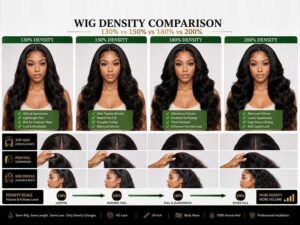
Chaque densité, De près
130% Densité
On dirait: Lumière, doux, naturel – proche de l’apparence d’une chevelure naturelle sans beaucoup de volume.
On a l'impression: Léger, respirant, confortable à porter toute la journée.
Idéal pour: Older clients wanting a natural mature look, women with naturally fine hair, anyone prioritizing realism over fullness, summer wear when heat is a concern.
Drawbacks: Can look thin if you’re used to fuller styles; doesn’t photograph as voluminously.
150% Densité
On dirait: Medium fullness — what most people picture when they think “healthy hair.” Photographs the most natural of all densities.
On a l'impression: Confortable, well-balanced, not heavy.
Idéal pour: Most beginners, anyone wanting maximum realism, content creators (it reads beautifully on camera), straight or sleek styles where less volume is desired.
Drawbacks: May feel “less full” than expected if you’re coming from synthetic wigs or have always worn high-density styles.
180% Densité
On dirait: Complet, glamour, voluminous — the classic “Black hair fullness” silhouette while still reading natural.
On a l'impression: Substantiel; you can feel the weight, especially in longer lengths.
Idéal pour: Les femmes noires veulent ça, aspect volumineux; textures bouclées et ondulées (qui ont besoin de plus de densité pour bien paraître); les femmes qui se sentent 150% a l'air trop mince.
Drawbacks: Un peu plus difficile de donner un aspect naturel à la pièce; plus chaud à porter; plus lourd sur le cou pour des longueurs plus longues.
200% Densité
On dirait: Très épais, dense, souvent visiblement “en forme de perruque” dans l'éclairage de tous les jours.
On a l'impression: Lourd, especially in longer lengths.
Idéal pour: Représentation sur scène, vidéos musicales, regards dramatiques, des événements délibérément glamour où le réalisme n'est pas la priorité.
Drawbacks: Ne se lit pas naturellement pour un usage quotidien; chaud; lourd; la partie est beaucoup plus difficile à faire ressembler au cuir chevelu.
250%+ Densité
On dirait: Extrêmement épais, territoire costumé.
Idéal pour: Représentation sur scène, travail de personnage, utilisation du costume, industrie de la musique, des regards dramatiques très spécifiques.
Drawbacks: Se lit évidemment comme une perruque; lourd; chaud; difficile à coiffer naturellement.
Le 150% contre 180% Débat
Il s'agit de la décision de densité la plus courante pour les femmes noires, donc il mérite sa propre section. Les deux fonctionnent bien; la bonne réponse dépend de ce que tu veux.
| Facteur | 150% | 180% |
|---|---|---|
| Des photographies comme | Le plus naturel | Plein et luxuriant |
| Best texture | Straight, sleek styles | Body wave, bouclé, volumineux |
| Weight | Lumière, comfortable | Substantiel |
| Heat | Cooler | Warmer |
| Part appearance | Easy to make natural | Slightly harder |
| “Reads as wig” risk | Lowest | Faible (with good prep) |
| Glam factor | Subtle | Strong |
Density by Texture
Texture changes how density reads visually. The same percentage on different textures looks different:
- Straight hair: Density reads heavier. 150% on straight looks like 180% on curly. Going too high (200%+) makes straight hair look obviously thick.
- Body wave: 150-180% is the sweet spot. The wave hides some density, so a fuller look works.
- Deep wave / boucles lâches: 180% looks naturally full. 150% can look thin on curly textures.
- Kinky curly: 180-200% reads as natural fullness. Lower densities can look sparse.
- Afro/kinky: 200%+ is often appropriate for the natural volume the texture suggests.
Density by Length
Length also affects how density reads:
- Short (8-14″): Higher density (180-200%) maintains shape and prevents the wig from looking thin. Short hair with low density falls flat.
- Moyen (16-20″): 150-180% is the sweet spot for most styles and faces.
- Long (22-26″): 150% often looks more natural — high density at long lengths reads as obviously thick. The weight also becomes a real factor.
- Extra long (28″+): 130-150% seulement. Higher density at these lengths is heavy, chaud, and looks costume-like.
Density by Face Shape
| Forme du visage | Densité recommandée | Pourquoi |
|---|---|---|
| Visage rond | 150% avec parties latérales | Évitez d'ajouter du volume qui met l'accent sur la rondeur |
| Visage ovale | N'importe lequel (150-180%) | La plupart des formes de visage fonctionnent avec n'importe quelle densité |
| Visage long | 180% | Longueur des soldes de volume |
| Visage carré | 180% avec des vagues douces | Adoucit les traits angulaires |
| En forme de coeur | 150-180% | Soit ça marche; penchez-vous plus en bas |
Pourquoi la densité affecte l'apparence naturelle de la perruque
C'est la partie qui manque à la plupart des blogs. La densité est l'un des facteurs les plus importants pour déterminer si une perruque est naturelle ou fausse., et pas comme la plupart des gens le pensent.
L'instinct est “plus de densité = plus luxueux = plus belle apparence.” Mais les vrais cheveux naturels ne poussent pas à 200% densité. Les cheveux naturels d’une femme moyenne traînent 100-130% densité. Quand tu portes un 200% perruque de densité, le volume est nettement supérieur à ce que vos amis et collègues s'attendraient à voir - et le cerveau enregistre “something’s off.”
The wigs that look the most natural in real life and in photographs are 150% — sometimes 180% with the right styling. Anything beyond that starts to read as costume.
Erreurs courantes de densité
Erreur 1: Par défaut, la densité la plus élevée disponible
Plus n'est pas toujours mieux. 200%+ la densité sur les vêtements de tous les jours se lit comme une perruque de costume.
Erreur 2: Ignorer complètement la densité
Certaines marques ne divulguent pas la densité. Acheter sans savoir, c'est jouer. Si une marque ne répertorie pas la densité, demander - ou passer à autre chose.
Erreur 3: La densité est mal adaptée à votre longueur
La haute densité sur de grandes longueurs se lit comme étant évidemment épaisse. Une densité plus faible sur de courtes longueurs se lit comme clairsemée. Faites correspondre les deux.
Erreur 4: Choisir la densité en fonction de ce qui semble bon sur les photos du produit
L’éclairage de studio flatte la haute densité. La vraie vie ne le fait pas. Choisissez pour l'éclairage de tous les jours, pas pour le marketing.
Erreur 5: En supposant que la densité détermine la qualité des cheveux
La densité et la qualité sont indépendantes. A high-density wig with non-Remy hair is worse than a 150% wig with virgin Remy hair. Density is one spec among many.
How to Thin a Wig That’s Too Dense (If You Already Bought It)
If you ended up with a 200%+ density wig and it looks too thick, you have options:
- Take it to a stylist for a careful thinning. A pro can remove density evenly without making it look choppy.
- Pluck the hairline more aggressively to soften the front (the most visible area).
- Wear it with looser textures — curls and waves hide volume more than straight styles.
- Use it for events where the glam look is wanted, and buy a more reasonable density for everyday wear.
Note: you can’t reverse density once hair is removed. Better to choose correctly upfront than thin afterward.
LE VERDICT FINAL DE NOTRE ÉQUIPEPour la plupart des femmes noires qui achètent une perruque en dentelle 2026: 150% si vous voulez un maximum de réalisme (surtout pour les styles droits ou la création de contenu), 180% si tu veux une plénitude qui reste naturelle (spécialement pour les textures body wave ou bouclées).
Éviter 200%+ à porter au quotidien. Il est magnifique sur les photos du produit et évidemment faux sous un éclairage normal. Réserver la haute densité pour la scène, événements, ou des regards dramatiques spécifiques.
La densité est l’une des caractéristiques les plus importantes quant à l’apparence naturelle de votre perruque.. Choisissez-le avec autant de soin que vous choisissez la qualité des cheveux et le type de dentelle.
Foire aux questions
Quelle est la densité de perruque en dentelle la plus naturelle?
150%. C'est le plus proche d'une chevelure naturelle typique et photographie de la manière la plus réaliste sous un éclairage normal.. Pour les femmes noires qui veulent plus de volume et qui restent naturelles, 180% est un deuxième choix solide.
Est 200% densité trop importante pour un usage quotidien?
Pour la plupart des gens, Oui. 200% La densité photographie magnifiquement sous l'éclairage de studio, mais se lit comme évidemment épaisse dans un éclairage fluorescent de bureau et à la lumière naturelle du jour.. C'est mieux adapté à la scène, événements, ou des looks dramatiques plutôt que des vêtements de tous les jours.
Quelle densité la plupart des femmes noires achètent-elles?
180% est la demande la plus populaire, parce qu'il offre une plénitude qui se lit comme étant saine “good hair” in our community’s visual culture. 150% est le plus naturel et gagne en popularité pour son apparence et son contenu réalistes. Les deux sont valables – le choix dépend du look que vous souhaitez.
La densité affecte-t-elle le confort de la perruque?
Oui. Les perruques de densité plus élevée sont plus lourdes (plus de cheveux sur la casquette) et plus chaud (moins de débit d'air). 200%+ la densité en été ou dans les climats chauds peut être véritablement inconfortable. Les densités plus légères sont plus confortables pour une utilisation prolongée.
Puis-je ajouter de la densité à une perruque trop fine?
Pas facilement. L'ajout de densité nécessite une reventilation professionnelle, ce qui est cher et n'en vaut pas la peine sur la plupart des unités. Mieux vaut acheter la bonne densité dès le départ, ou portez une perruque pour plus de volume si nécessaire.
Les perruques bouclées devraient-elles avoir une densité plus élevée que les perruques droites?
Oui, en général. Les textures bouclées et ondulées cachent visuellement une certaine densité, donc un 180% La perruque bouclée ressemble en plénitude à une 150% perruque droite. Aller trop bas sur les textures bouclées peut les rendre fines et filandreuses..
Comment la densité affecte-t-elle le prix?
Une densité plus élevée coûte plus cher, car cela nécessite plus de cheveux et plus de travail de ventilation. La différence de prix entre 150% et 180% est généralement 15-25% pour la même perruque.
Quelle doit être la densité de ma première perruque en dentelle?
Pour la plupart des premiers acheteurs, 150-180%. Restez dans cette plage pour le meilleur équilibre d’aspect naturel, confort, et flexibilité de style. Éviter 200%+ pour votre première unité, sauf si vous souhaitez spécifiquement un effet dramatique, aspect volumineux.
Continuer l'apprentissage
- [Lien interne vers le blog #1] Le guide complet des perruques en dentelle
- [Lien interne vers le blog #2] Types de perruques en dentelle expliqués
- [Lien interne vers le blog #13] Comment donner à une perruque un aspect naturel: 12 Conseils de pro
- [Lien interne vers le blog #15] Pourquoi ma perruque en dentelle a-t-elle l'air fausse?
- [Lien interne vers le blog #19] Que rechercher lors de l’achat de votre première perruque en dentelle
- [Lien interne vers le blog #26]Pourquoi les perruques de cheveux humains bon marché tombent-elles si vite?