
Este guia aborda todas as diferenças significativas entre uma peruca de cabelo humano e uma peruca sintética - incluindo perucas sintéticas., que ficam em algum lugar no meio. No final, você saberá exatamente qual tipo atende às suas necessidades, seu orçamento, e o tempo que você está disposto a dedicar aos cuidados com as perucas.
Perucas de cabelo humano são cabelos reais amarrados em uma base de renda - parecem mais naturais, pode ser estilizado com calor, durar 1-3 anos, e custo $150-$1,000+. Perucas sintéticas são feitos de fibras artificiais – são mais baratos ($30-$150), venha pré-estilizado, normalmente não pode ser estilizado com calor, e por último 3-6 meses. Para mulheres negras que usam perucas várias vezes por semana, renda de cabelo humano é o melhor investimento a longo prazo. Para uso ocasional, fantasias, ou experimentação de cores, sintético é a escolha inteligente de orçamento.
O que cada tipo de peruca realmente é
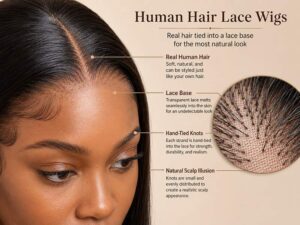
Perucas de cabelo humano
Human hair lace wigs are made from real human hair — usually sourced from India, parts of Southeast Asia, China, or Eastern Europe — tied by hand into a sheer lace base. Because the hair is real, it can be washed, conditioned, colored, heat-styled, and treated like your own hair. The lace base creates an invisible hairline that mimics scalp.
Perucas sintéticas (non-lace)
Synthetic wigs are made from man-made fibers — typically Kanekalon or Toyokalon — woven into a regular wig cap. They come pre-styled in a fixed shape that holds well over time. Most synthetic fibers can’t tolerate normal styling heat, though heat-resistant synthetic fibers exist with temperature limits.
Synthetic lace wigs (hybrid)
Synthetic lace wigs combine a lace front with synthetic hair. They give you the realistic hairline of a lace wig at a fraction of the cost of human hair. Quality varies widely. The hair itself still has the limitations of synthetic — limited heat styling, shorter lifespan, slight shine in sunlight.
Direct Comparison
| Factor | Human Hair Lace Wig | Synthetic Lace Wig | Regular Synthetic Wig |
|---|---|---|---|
| Material | Real human hair | Man-made fibers + lace | Man-made fibers only |
| Hairline | Invisible lace | Visible lace (low-mid quality) | No lace — visible cap line |
| Heat styling | Sim, like real hair | Limited (heat-resistant only) | Usually no |
| Coloring | Sim, with care | Não | Não |
| Lifespan | 1-3 anos | 3-6 meses | 3-6 meses |
| Initial cost | $150-$1,000+ | $60-$200 | $30-$150 |
| Cost per wear (1 year, daily) | $0.80-$3.00 | $0.50-$1.10 | $0.20-$0.80 |
| Look in person | Indistinguishable from real | Looks like a wig up close | Obvious wig from arm’s length |
| Tangle risk | Low if Remy | High over time | High over time |
| Maintenance | Wash, condition, style | Wash gently, no heat | Wash gently, hold shape |

The Look: How Each Wig Type Actually Photographs
A diferença visual entre o cabelo humano e o sintético não é sutil pessoalmente, mesmo que as fotos dos produtos possam torná-los semelhantes.
Perucas de cabelo humano
- À luz do dia: Indistinguível do cabelo real, especialmente com instalação adequada
- Sob flash: A linha do cabelo pode derreter perfeitamente com renda HD
- Em vídeo: O movimento parece natural, o cabelo cai e salta de forma realista
- De perto: Fios individuais parecem reais porque são reais
Perucas sintéticas
- À luz do dia: Ligeiro brilho que revela a fibra sintética, especialmente sob luz solar direta
- Sob flash: Muitas vezes mostra a touca da peruca ou a borda do couro cabeludo
- Em vídeo: O movimento é mais rígido – o sintético não se move como o cabelo real
- De perto: As fibras parecem ligeiramente uniformes, sem a variação do cabelo real
Custo: A verdadeira matemática
A etiqueta de preço não é tudo. Para comparar honestamente, você precisa analisar o custo por uso durante a vida útil real da peruca.
Synthetic wig cost example
- Initial cost: $50
- Lifespan with daily wear: 4 meses (~120 wears)
- Cost per wear: $0.42
- Annual cost (replacing 3x per year): $150
Human hair lace wig cost example
- Initial cost: $300
- Lifespan with daily wear: 18 meses (~540 wears)
- Cost per wear: $0.56
- Annual cost (replacing every 1.5 anos): $200
The annual costs are actually similar. Where human hair pulls ahead is in look quality per dollar — for roughly the same yearly spend, you get a vastly better-looking wig for the majority of the year.
Here’s a math point most blogs miss: a $50 synthetic wig and a $300 human hair lace wig usually have similar annual costs when you account for replacement frequency. The question isn’t really “which is cheaper” — it’s “which look quality do you want to live with day to day?” That framing changes the decision for most buyers.
When Synthetic Wigs Make Sense
Despite human hair’s advantages, synthetic wigs genuinely have a place. Our team recommends synthetic for:
Occasional wear
If you only wear a wig once or twice a month — for events, costume parties, or special occasions — synthetic makes complete sense. You don’t need the longevity of human hair, and you save hundreds of dollars.
Color experimentation
Want to try pink, electric blue, or rainbow tips? Don’t bleach a $400 human hair wig to do it. Buy a $40 synthetic in that color and have fun.
Trying a new style first
Considering a dramatic cut, color, or texture change? Test it with synthetic before committing to a human hair version. If you love it, upgrade.
Costume and theatrical use
Halloween, cosplay, stage performance — synthetic is the right choice every time.
Backup or “off-duty” peruca
Ter uma peruca sintética em sua rotação permite que você troque rapidamente quando sua peruca de cabelo humano estiver sendo lavada ou modelada.
Orçamento rigoroso
Se $300 não está no orçamento agora, uma peruca de renda sintética no $80-$150 A linha oferece uma linha fina e uma aparência usável sem o investimento em cabelo humano.
Quando as perucas de cabelo humano valem a pena
Você usa peruca várias vezes por semana
Usuários diários e quase diários obtêm mais valor do cabelo humano. O visual, a durabilidade, e a versatilidade do estilo é importante quando a peruca faz parte da sua vida normal.
Você filma conteúdo
Câmeras expõem todas as falhas sintéticas. Se o seu cabelo estiver na câmera do TikTok, YouTube, Instagram, ou qualquer tipo de trabalho de conteúdo, a qualidade da aparência do cabelo humano se paga.
Você quer pentear seu cabelo de maneira diferente a cada dia
Cachos um dia, elegante o próximo, metade do terceiro - as perucas sintéticas mantêm seu estilo predefinido. O cabelo humano pode ser remodelado livremente.
Você quer uma linha de cabelo de verdade
Existem perucas sintéticas, mas a qualidade da renda nas faixas de preço mais baixas geralmente mostra. Para uma linha do cabelo verdadeiramente invisível, renda de cabelo humano continua sendo o padrão.
Você está protegendo seu cabelo natural
Perucas são um estilo protetor. Para a saúde do cabelo a longo prazo, investir em uma unidade de qualidade que proteja adequadamente seu cabelo natural compensa na retenção.
Você quer uma peruca que cresça com você
O cabelo humano pode ser remodelado, recolorido, re-texturizado, e reutilizado por anos. As perucas sintéticas prendem você ao visual que vieram com elas.
Equívocos comuns
“Sintético é sempre mais barato”
Verdadeiro inicialmente, mas não necessariamente ao longo do tempo. A matemática do custo por uso geralmente chega mais perto do que as pessoas esperam.
“Cabelo humano sempre fica melhor”
Verdade se você investir em qualidade. UM $80 “cabelo humano” A peruca de um mercado geralmente é um cabelo não Remy que se embaraça em semanas - na verdade, pode parecer pior do que um cabelo sintético premium.
“Perucas sintéticas são mais fáceis de usar”
Às vezes é verdade. Perucas sintéticas mantêm seu estilo, então você não precisa reestilizá-los. Mas também são mais difíceis de instalar naturalmente (sem frente de renda nas opções de orçamento) e não duram o suficiente para desenvolver habilidades com.
“O cabelo humano é muito caro para a maioria das pessoas”
Isso não é mais verdade. Frentes de renda de cabelo humano decentes começam $150-$200, que é comparável a um bom sintético. O “luxo” o preço é para notas premium, não para cabelo humano básico.
“Todo sintético parece falso”
Sintético mais antigo, sim. Modern heat-resistant premium synthetic lace wigs can look surprisingly real — though still not quite human-hair-level.
Buying Recommendations
If you’re buying your first wig
Start with a budget-to-mid synthetic lace wig ($80-$150). You’ll learn whether wig-wearing is for you, what styles you prefer, and how to install — without committing $300+ before you know what you want.
If you’ve worn wigs before and you wear daily
Upgrade to a human hair lace front ($200-$400). The look quality jump is significant, and you’ll get full value from the longer lifespan.
If you want versatility across occasions
Own both. UM premium human hair lace wig for daily wear and content, plus a fun synthetic for color experimentation, themed events, or off-duty days.
If you’re on a tight budget
A well-made synthetic lace wig in the $100-$150 range supera um mal feito “cabelo humano” peruca pelo mesmo preço. A qualidade é mais importante do que o rótulo do material neste nível.
Diferenças de cuidado: O que você está se inscrevendo
Perucas de cabelo humano
- Lave cada 7-10 usa com shampoo sem sulfato + condicionador profundo
- Seque ao ar livre em um suporte de peruca
- Use protetor térmico antes de modelar
- Desembarace suavemente com pente de dentes largos
- Armazene em uma cabeça de manequim
- Durma em cetim ou tire à noite
Perucas sintéticas
- Lave com menos frequência (todo 10-15 usa) com água fria e shampoo específico para sintéticos
- Nenhum estilo térmico, a menos que fibra resistente ao calor (e mesmo assim, apenas fogo baixo)
- Desembaraçar suavemente – as fibras sintéticas emaranham-se e quebram-se facilmente
- Guarde em um suporte de peruca para preservar o estilo predefinido
- Evite luz solar direta, que desbota cores sintéticas
Perguntas frequentes
Vale a pena comprar perucas sintéticas?
Sim, na faixa de preço certa. UM $100-$150 peruca de renda sintética oferece uma linha do cabelo realista a um preço muito mais baixo do que o cabelo humano. Esteja ciente das compensações: shorter lifespan, estilo de calor limitado, e leve brilho sob luz forte.
Posso aquecer uma peruca sintética?
Somente se a embalagem especificar fibras resistentes ao calor, e mesmo assim, siga os limites de temperatura cuidadosamente (geralmente abaixo de 300°F). A maioria das perucas sintéticas derrete ou deforma permanentemente com chapinhas comuns ou modeladores de cachos.
Quanto tempo dura um $50 peruca sintética realmente dura?
3-4 meses de uso regular, menos se você usar diariamente. As fibras emaranham-se progressivamente ao longo do tempo e o estilo fica achatado. Depois 4 meses, a maioria das perucas sintéticas precisam ser substituídas para que a aparência ainda seja aceitável.
Por que meu $200 peruca de cabelo humano parece pior do que a peruca sintética do meu amigo?
Provavelmente uma das três razões: (1) é o cabelo não-Remy que está emaranhado e emaranhado, (2) na verdade não é 100% cabelo humano apesar do rótulo, ou (3) the install/styling work is making it look fake. Quality varies wildly in the budget human hair tier.
Can I dye a synthetic wig?
Not really. Standard hair dyes don’t bind to synthetic fibers — they wash out or leave the wig looking patchy. Some specialty synthetic dyes exist, but the results are inconsistent. If you want a specific color, buy a synthetic wig already in that color.
Is human hair better for sensitive scalps?
Generally yes. Synthetic fibers can sometimes cause itching or irritation on sensitive skin. Human hair is gentler and doesn’t trap heat as much as synthetic.
What’s the cheapest decent lace wig I can buy?
Around $100-$120 for a synthetic lace front, ou $150-$200 for an entry-level human hair lace front. Below these prices, você está obtendo cabelo humano sintético de qualidade muito baixa ou não Remy que não terá um bom desempenho.
Continuar aprendendo
- [Link interno para o blog #1] O guia completo para perucas de renda
- [Link interno para o blog #2] Tipos de perucas explicadas
- [Link interno para o blog #8] Cabelo Brasileiro vs Peruano vs Indiano: O que as mulheres negras deveriam saber
- [Link interno para o blog #19] O que procurar ao comprar sua primeira peruca de renda
- [Link interno para o blog #20] Guia de densidade de peruca de renda: 130%, 150%, 180%
- [Link interno para o blog #26]Por que as perucas baratas de cabelo humano caem tão rápido?