
Published: May 2026 | Last updated: May 2026 Reading time: 14 minutes
If you’ve ever pulled your lace wig out of the wash matted, frizzy, or shedding hair in clumps — you’re not alone. Our team gets messages from women every week saying their $300 wig “fell apart” after the first wash. Nine times out of ten, the wig is fine. The wash routine wrecked it.
Washing a lace wig isn’t the same as washing your own hair, and it’s nothing like washing clothes. The hair on a lace wig has no scalp feeding it nutrients, no natural oil supply, and a delicate hand-tied lace base that snaps under stress. Treat it like normal hair and it will tangle, shed, and lose its shape within a few washes.
This guide walks through the exact wash routine our stylist team uses on thousands of human hair lace wigs every year. We cover frequency, products, technique, drying, and the small mistakes that quietly shorten your wig’s lifespan.
Wash a human hair lace wig every 7-10 wears using sulfate-free shampoo and deep conditioner. Detangle gently before washing, then submerge the wig in cool-to-lukewarm water, apply shampoo in downward strokes (never rub or scrub), rinse, deep condition for 15-30 minutes, rinse again, and air-dry on a wig stand. Never twist, wring, or scrub the lace. The whole process takes about 30 minutes plus drying time.
How Often Should You Wash a Lace Wig?
Wash frequency is the question our team gets asked the most about wig care. The honest answer depends on how often you wear the wig and how much product you use.
| Wear Pattern | Wash Every | Notes |
|---|---|---|
| Daily wear | 7-10 days | Sooner if you use heavy products or sweat |
| 3-4x per week | Every 2-3 weeks | Once you see buildup at the part |
| 1-2x per week | Every 4-6 weeks | Or whenever the hair feels heavy/dull |
| Occasional / event wear | After every install | Especially if products and adhesive were used |
Over-washing damages a wig as much as under-washing. Every wash strips a small amount of the hair’s natural oils (or in the case of processed hair, the silicone coating), so washing too often shortens lifespan dramatically.
Signs your wig needs a wash:
- The hair feels heavy or limp
- You can see product or sweat buildup at the part
- The hair loses its bounce or curl pattern
- You can smell sweat, smoke, or perfume on the wig
- The hairline feels sticky from edge control residue
What You’ll Need
Before starting, gather everything. Trying to wash a wig and reach for products mid-wash leads to mistakes.
- Sulfate-free shampoo — sulfates strip color and damage cuticles. Look for “sulfate-free” on the label.
- Deep conditioner — moisturizing, sulfate-free, ideally formulated for color-treated or dry hair.
- Wide-tooth comb — for detangling before and after the wash.
- Microfiber towel — gentler than regular cotton towels. T-shirts work too.
- Wig stand or mannequin head — for drying. Critical.
- Optional: leave-in conditioner, hair oil, heat protectant — for finishing the dry wig.
The Complete Wash Process (Step-by-Step)
Follow each step carefully — the order matters more than you’d think.
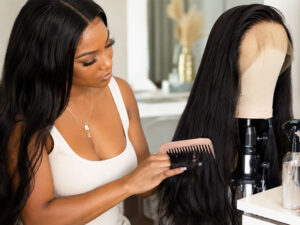
STEP 1 Detangle Before Wetting
This is the single most important step, and the one most beginners skip.
- Place the wig on a wig stand or mannequin head (or lay flat on a table)
- Start at the ends, not the roots
- Using a wide-tooth comb, work small sections at a time
- Hold the section at the root with one hand to prevent pulling on the lace
- Slowly work your way up toward the roots, one inch at a time
Water locks tangles in. Trying to detangle a wet, tangled wig will tear the hair out and stretch the lace. Always detangle dry first.
STEP 2 Remove Any Glue or Adhesive Residue
If you wore the wig with adhesive (lace glue, Got2B Glued, etc.), clean the lace edge before submerging it in water.
- Apply adhesive remover (Walker Tape C-22, isopropyl alcohol, or your brand’s remover) to a cotton swab or pad
- Gently dab and rub along the inside of the lace where the adhesive sits
- Continue until the lace feels smooth, not sticky
- Skipping this step lets adhesive harden during the wash, making it permanently embedded in the lace
STEP 3 Fill a Basin with Cool-to-Lukewarm Water
Use a clean sink or basin. Fill with enough water to fully submerge the wig.
- Water temperature: cool to lukewarm, never hot
- Hot water damages the hair cuticle, tightens curl patterns unevenly, and can warp the lace cap shape
- If you’re not sure, err on the cooler side

STEP 4 Submerge and Apply Shampoo
This is where most damage happens. The key is gentle, downward motion only.
- Lower the wig into the water hairline first, fully submerge it
- Let it soak for 1-2 minutes — this loosens dirt and product buildup
- Apply a quarter-sized amount of sulfate-free shampoo to your palms
- Work the shampoo through the hair using downward strokes only — from root to tip
- Never scrub, swirl, or rub in circles. This causes tangling and shedding.
- For the lace cap, gently squeeze (don’t twist) the shampoo through
- For the hairline area, lightly massage with fingertips to remove sweat and product

STEP 5 Rinse Thoroughly
- Drain the soapy water from the basin
- Refill with clean, cool-to-lukewarm water
- Submerge and gently swish the wig until the water runs clear
- You may need to refill the basin 2-3 times to get all the shampoo out
- Residue left in the wig makes the hair look dull and feel heavy
You can also rinse under a gentle stream of running water if your sink allows. Hold the wig from the cap (not the hair) and let water flow from roots to tips.
STEP 6 Apply Deep Conditioner
This is where you restore moisture to hair that has no scalp providing oils.
- Gently squeeze excess water from the wig (do not wring)
- Apply a generous amount of deep conditioner to your palms
- Work it through the hair from mid-length to ends — avoid the cap and roots
- For curly or wavy units, use slightly more product than for straight hair
- Comb through gently with a wide-tooth comb to distribute evenly
- Place the wig in a plastic shower cap or wrap in a towel
- Let it sit for 15-30 minutes (longer for processed or older hair)
Don’t apply heat to speed this up. Room temperature works fine. If you want deeper penetration, you can leave it overnight in a sealed plastic bag.
STEP 7 Rinse the Conditioner
- Use cool water — cool water seals the cuticle and helps the hair retain moisture and shine
- Rinse until the water runs clear and the hair feels smooth, not slippery
- Don’t over-rinse — leaving a tiny amount of conditioner residue helps keep the hair soft
STEP 8 Gently Remove Excess Water
- Lay the wig flat on a microfiber towel or clean cotton T-shirt
- Press (don’t rub) to absorb excess water
- Wrap loosely in the towel for 5-10 minutes to draw out more moisture
- Never twist or wring — this stretches the lace and damages individual hairs
STEP 9 Apply Leave-In Products (Optional but Recommended)
While the wig is damp:
- Apply a small amount of leave-in conditioner from mid-length to ends
- For curly textures, add a curl-defining cream or mousse
- Add a few drops of lightweight hair oil (argan, jojoba, or a lightweight serum) to seal moisture
- Less is more — start with a pea-sized amount and add as needed
STEP 10 Air-Dry on a Wig Stand
This step alone determines how long your wig lasts.
- Place the wig on a wig stand or mannequin head in its natural style
- Let it air-dry completely — usually 6-12 hours depending on length and density
- For curly textures, gently scrunch curls as the wig dries to set the curl pattern
- For straight textures, finger-comb periodically as it dries to prevent stiffness
- Keep out of direct sunlight, which fades color and dries hair
- Never use a blow dryer unless absolutely necessary (and only on cool setting)
Air-drying isn’t just about avoiding heat damage. The wig dries into the shape of whatever it sits on while wet. A wig laid flat on a counter dries flat. A wig on a stand dries in its natural cap shape and the hair falls correctly. This single detail is why our team will never recommend drying any other way unless you’re in a genuine emergency.
Curly and Textured Lace Wig Wash Notes
If your wig has body wave, deep wave, curly, or kinky texture, the routine above mostly applies — but with a few important adjustments.
For body wave and deep wave
- Add a curl-activating product (mousse or curl cream) while the wig is damp
- Gently scrunch the curls upward as you apply
- Don’t comb through after applying — finger-style only
- Let dry undisturbed to preserve the wave pattern
For curly and kinky textures
- Use the LOC method on damp hair (Leave-in, Oil, Cream) for maximum moisture
- Detangle only when fully saturated with conditioner
- Never brush dry curly hair — it destroys the curl pattern
- Refresh between washes with a water + leave-in conditioner spray, not by re-washing
What to Do If Your Wig Is Already Tangled or Matted
If your wig is past the point of normal washing — tangled, matted, or in clumps — don’t panic and don’t throw it out. There’s a rescue routine that often works.
- Lay the wig flat or on a stand
- Saturate the matted area with a generous amount of conditioner (deep conditioner, not rinse-out)
- Add a small amount of hair oil on top of the conditioner
- Let it sit for 30-60 minutes — the oil and conditioner combination slowly unsticks the strands
- Use your fingers (not a comb) to slowly separate the matted clumps from the ends upward
- Once you can see individual strands moving, switch to a wide-tooth comb
- Then proceed with the normal wash routine
If the matting is severe and the hair has fused together (sometimes called “felting”), the unit may be beyond recovery — this usually happens with non-Remy hair after multiple washes. In that case, the silicone coating has worn off and the cuticle-stripped hair has tangled permanently.
Mistakes That Quietly Destroy Your Lace Wig
These are the most common ones — and the ones that do the most damage.
Mistake 1: Hot water
What happens: Hair cuticle damage, color fading, curl pattern relaxation, lace warping.
Fix: Cool to lukewarm only. If your hand can comfortably stay in the water indefinitely, the temperature is fine.
Mistake 2: Rubbing or scrubbing
What happens: Cuticles lift, strands snag, tangling accelerates over the next several wears.
Fix: Downward strokes only. Imagine the hair as silk thread.
Mistake 3: Sulfate-based shampoo
What happens: Strips natural oils, fades color, dries out the hair quickly.
Fix: Sulfate-free shampoo only. The bottle should explicitly say so.
Mistake 4: Twisting or wringing
What happens: Lace stretches and tears at the ear tabs, individual hairs snap.
Fix: Press water out with a towel, never wring.
Mistake 5: Blow-drying on high heat
What happens: Frizz, breakage, lifespan shortens by months.
Fix: Air-dry. If you must blow-dry, use cool setting only.
Mistake 6: Brushing while wet
What happens: Hair stretches and breaks because wet hair is at its weakest.
Fix: Detangle dry, finger-style wet.
Mistake 7: Washing too often
What happens: Strips moisture faster than the wig can recover, dramatically shortens lifespan.
Fix: Stick to the every-7-10-wears schedule unless heavily soiled.
Mistake 8: Not deep conditioning
What happens: Wig becomes increasingly dry, brittle, and frizzy over each wash.
Fix: Deep condition every single wash, no exceptions.
Mistake 9: Skipping the detangle before washing
What happens: Wet tangles get worse, hair breaks during washing.
Fix: Always detangle fully on a dry wig before any water touches it.
Mistake 10: Drying flat on a counter
What happens: Wig loses its cap shape, hair flattens, drying takes twice as long.
Fix: Always use a wig stand or mannequin head.
How to Make Your Lace Wig Last Longer Between Washes
The fewer washes a wig needs, the longer it lasts. Here are our team’s tips for extending wear between washes:
- Wrap with satin at night. Sleeping on cotton creates friction; satin protects both the hair and the lace.
- Use a wig grip or elastic band to reduce direct skin-to-lace contact (less sweat reaches the hair).
- Avoid heavy product application. Edge control and styling cream buildup is the main reason wigs need washing.
- Mist a leave-in conditioner spray between wears to refresh moisture without washing.
- Take the wig off when you sleep (if glueless) to give it time to air out.
- Brush gently each evening with a wig brush to remove dust and prevent tangling.
How to Wash a Synthetic Lace Wig (Brief Notes)
This guide focuses on human hair wigs, but if you have a synthetic lace wig, here’s a quick summary of the key differences:
- Use cool water only — even lukewarm can damage synthetic fibers
- Use synthetic-specific shampoo or baby shampoo
- Wash less frequently — every 10-15 wears or whenever obvious buildup appears
- Skip the deep conditioner — synthetic doesn’t absorb moisture the way human hair does. Use a synthetic-specific conditioner spray instead.
- Air-dry on a stand, never with heat
- Do not brush while wet
Frequently Asked Questions
How often should I wash my lace wig?
For human hair lace wigs worn daily, every 7-10 wears. For occasional wear, every 4-6 weeks. Wash sooner if you notice buildup, dullness, or odor.
Can I use regular shampoo on my lace wig?
Not recommended. Regular drugstore shampoos usually contain sulfates that strip the hair’s protective oils and shorten the wig’s lifespan dramatically. Always use sulfate-free shampoo.
Can I wash a lace wig while it’s installed on my head?
You can, but our team strongly recommends against it. Washing in place doesn’t let you clean the cap properly, water gets trapped at the scalp, and you can’t deep condition or detangle the wig effectively. Take it down first.
What’s the best shampoo for lace wigs?
Look for sulfate-free, moisturizing shampoos. Brands frequently recommended by our stylist team include those designed for color-treated, curly, or extension hair. Specific products vary, but the formulation matters more than the brand.
Can I use hot water if the wig is really dirty?
No. Even when the wig is heavily soiled, stick to cool-to-lukewarm water. Use a clarifying shampoo or do a clarifying rinse with diluted apple cider vinegar instead — heat will damage the wig more than the dirt will.
How long does a wig take to air-dry?
6-12 hours for most human hair lace wigs, depending on length, density, and texture. Thicker and longer units take longer. Drying overnight is usually most convenient.
Can I blow-dry my lace wig?
Only on cool setting and only when necessary. Blow-drying on heat shortens wig lifespan by months. If you’re in a rush, gently towel-dry to remove maximum moisture, then air-dry the rest.
Why does my wig still feel dry after washing?
Usually one of three reasons: (1) the conditioner didn’t sit long enough (try 30+ minutes next time), (2) you’re using a conditioner that’s too lightweight, or (3) the hair is processed/non-Remy and the cuticle damage means it can’t retain moisture well. Try a heavier moisturizing mask.
Can I dye my lace wig after washing?
Wait at least 48 hours after washing before dyeing. The hair needs to be fully dry and the cuticle needs to settle. Coloring damp hair leads to uneven absorption and patchy results.
Continue Learning
- [Internal link to Blog #1] The Complete Guide to Lace Wigs
- [Internal link to Blog #3] How to Install a Lace Wig: Step-by-Step
- [Internal link to Blog #13] How to Make a Lace Wig Look Natural: 12 Pro Tips
- [Internal link to Blog #17] Why Is My Lace Lifting? How to Keep Your Wig Secured
- [Internal link to Blog #14] How to Wear a Lace Wig for the First Time