
Publicado: Puede 2026 | Última actualización: Puede 2026 tiempo de lectura: 16 minutos
Si alguna vez navegaste por Instagram o TikTok y te preguntaste cómo se ve la línea del cabello de alguien eso impecable, es probable que estuvieras mirando una peluca de encaje. Las pelucas de encaje han cambiado por completo la forma en que usan las mujeres negras, cambiar, y proteger su cabello, pero el mundo del encaje también puede resultar abrumador cuando recién estás comenzando.
encaje de alta definición, encaje transparente, 13×4, 13×6, sin pegamento, nudos blanqueados, líneas de cabello depiladas: la terminología por sí sola puede detener a un principiante en seco.
Al final de esta guía, entenderás:
- Qué es realmente una peluca de encaje y qué no es realmente una peluca de encaje
- Todos los tipos principales de encaje y en qué se diferencian en su apariencia., sentir, y precio
- Cómo elegir la peluca de encaje adecuada para tu estilo de vida, tono de piel, y presupuesto
- Lo que los fabricantes no siempre te dicen sobre los precios, calidad, y abastecimiento de cabello
- Cómo instalar, cuidar a, y extienda la vida útil de su unidad
entremos en ello.
Respuesta rápida:
Una peluca de encaje es una peluca hecha con encaje transparente en la línea del cabello o en la gorra., con mechones de cabello atados al cordón para crear la apariencia de cabello que crece desde el cuero cabelludo. Para la mayoría de los principiantes, un 13×4 o 13×6 peluca delantera de encaje en 150% La densidad es el punto de partida más fácil porque ofrece una línea de cabello natural., despedida flexible, y un precio más manejable que las pelucas de encaje completo.
¿Qué es una peluca de encaje??
Una peluca de encaje es una peluca construida sobre una base de encaje transparente., con mechones individuales de cabello atados, o “ventilado” — en el encaje a mano. Cuando el encaje se sienta contra tu piel, desaparece. La ilusión es que el cabello crece directamente desde el cuero cabelludo..
Ese es el punto. A diferencia de las pelucas tradicionales que se colocan obviamente encima de la cabeza., Las pelucas de encaje te dan una línea de cabello de aspecto natural que puedes dividir en cualquier lugar., estilo de cualquier manera, y recogerse en una cola de caballo sin mostrar huellas, costuras, o una línea de peluca dura.
Tres cosas diferencian una peluca de encaje de una peluca normal:
- el material base. Las pelucas de encaje usan puro suizo., Francés, HD, o encaje transparente, diseñado para imitar el cuero cabelludo.
- Construcción atada a mano. Cada mechón de cabello se anuda en el encaje uno a la vez., Permitir que el cabello se mueva y se separe naturalmente en cualquier dirección..
- la línea del cabello. El encaje se extiende más allá de donde comienza el cabello., dándole un personalizable, Línea de cabello mezclable que desaparece contra tu piel..
Por qué las pelucas de encaje son tan populares entre las mujeres negras
Las pelucas de encaje no son solo una tendencia en nuestra comunidad, para muchas mujeres negras, son una herramienta de peinado diaria, un estilo protector, y un generador de confianza, todo en uno. Nuestro equipo ha observado cómo esta categoría pasó de ser un producto de nicho de celebridades a convertirse en un elemento esencial para la corriente principal., y las razones son claras:
Protegen el cabello natural. Peinado con calor constante, manipulación, y tipo de daño por procesamiento químico 3 y 4 texturas del cabello. Una peluca de encaje te permite cambiar tu apariencia sin tocar tu cabello real debajo, lo que significa que puedes aumentar la longitud y conservar los bordes sin dejar de lucir como quieras..
Imitan el cuero cabelludo en toda la gama de tonos de piel negros.. Esta es la parte que a menudo se malinterpreta.. Las pelucas de encaje de estilo antiguo se diseñaron originalmente para pieles más claras y se veían obvias en pieles más oscuras.. HD moderno y encaje transparente., cuando está adecuadamente blanqueado y teñido, combina perfectamente desde el caramelo claro hasta los tonos de ébano más profundos. La tecnología realmente se puso al día.
Permiten una versatilidad que la mayoría de los estilos no pueden igualar.. Una coleta alta, una parte lateral profunda, pelos de bebé colocados, un moño bajo y elegante: todo imposible con una peluca con gorra tradicional, Todo es posible con una unidad de encaje de calidad..
Ahorran tiempo. Una vez instalada la peluca de encaje, prepararse puede tomar 5 minutos. Sin bordes para planchar, sin giros que vayan hacia los lados, sin complicaciones de último momento antes del trabajo o una boda.
Esa combinación: protección, versatilidad, y una apariencia impecable: es difícil de encontrar en ningún otro lugar. Y es por eso que las pelucas de encaje pasaron de ser un artículo de lujo para celebridades y artistas escénicos a algo que la mujer promedio usa los martes..
El Diferentes tipos de encaje, Explicado
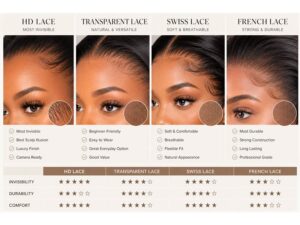
Aquí es donde la mayoría de los principiantes se pierden. “Cordón” No es un solo material, es toda una familia de materiales., y las diferencias importan. Esto es lo que realmente significa cada tipo, directamente desde nuestra planta de producción:
encaje de alta definición (Alta definición)
encaje de alta definición Es el encaje más fino y fino actualmente en producción en masa.. Es casi invisible contra la piel y solo necesita un tinte mínimo para igualar la tez más profunda..
- Lo mejor para: líneas de cabello de aspecto natural, sesiones de fotos, ocasiones especiales
- Ventajas: virtualmente invisible, suave, cómodo, fotografías bellamente
- Contras: delicado (Se rasga fácilmente si lo arrancas demasiado agresivamente.), mas caro, vida útil más corta cuando se manipula con brusquedad
Encaje transparente
El encaje transparente es claro., encaje ligero que viene de fábrica pretintado en un beige muy claro. Es más duradero que el encaje HD y funciona bien para tonos de piel medios a claros., aunque las pieles más oscuras generalmente necesitan teñirlo con base o tinte para telas..
- Lo mejor para: uso diario, principiantes, tonos de piel más claros a medios
- Ventajas: más duradero que HD, más fácil de instalar, económico
- Contras: necesita tinte en pieles más oscuras, ligeramente más visible que HD
encaje suizo
El encaje suizo es el estándar de oro tradicional: suave, indetectable, hecho con hilos más finos que el encaje francés estándar. Se ha utilizado en la fabricación de pelucas de alta gama durante décadas..
- Lo mejor para: desgaste a largo plazo, unidades personalizadas premium
- Ventajas: aspecto natural, suave contra la piel, suave con el cuero cabelludo
- Contras: frágil, caro, utilizado principalmente en unidades personalizadas y de lujo
encaje francés
El encaje francés es más resistente y duradero que el encaje suizo., pero un poco más visible. Las pelucas de encaje de gama media más asequibles utilizan encaje francés porque resiste bien las instalaciones y los lavados repetidos..
- Lo mejor para: uso diario, principiantes que quieren durabilidad
- Ventajas: durable, asequible, fácil de trabajar
- Contras: menos invisible que HD o Swiss
Estilos de peluca de encaje: Frente, Lleno, 360 y cierre
Más allá del propio material del encaje, Las pelucas de encaje vienen en diferentes estilos de construcción.. Cada estilo determina qué parte de la peluca es encaje atado a mano versus cabello tejido a máquina, y eso afecta tanto el precio como la versatilidad del estilo..
| Estilo | Cobertura de encaje | Mejor para | Precio típico |
|---|---|---|---|
| Cierre de encaje Peluca | 4×4 o 5×5 pulgadas en la parte superior | Opción de presupuesto, solo estilos de parte media | $60–$200 |
| Peluca frontal de encaje | 13×4 o 13×6 en el frente | Más popular: despedida versátil | $120–$400 |
| 360 peluca de encaje | Perímetro completo (frente + atrás) | colas de caballo, recogidos | $200–$500 |
| Peluca de encaje completa | Toda la gorra es de encaje. | Máxima versatilidad, sensación premium | $300–$1,000+ |
En nuestra experiencia trabajando , a la mayoría de las mujeres negras que comienzan les va mejor con una peluca frontal de encaje de 13×4 o 13×6. Le brinda la versatilidad de realizar separaciones en cualquier parte del frente., sin el precio (o la fragilidad) de una unidad de encaje completo.
Cabello humano vs.. Pelucas de encaje sintético
Casi todas las pelucas de encaje se clasifican en una de dos categorías.: cabello humano o sintético. La diferencia va mucho más allá del precio: afecta el aspecto de la peluca., cuanto dura, y que puedes hacer con el.
Pelucas de encaje de cabello humano
Hecho de cabello humano real (en la mayoría de los casos) de la india, partes del sudeste asiático, Porcelana, o Europa del Este. El cabello se puede teñir., estilo de calor, lavado, y tratado como si fuera tuyo, porque es pelo real.
- Esperanza de vida: 1 a 3 años con el cuidado adecuado
- Mirar: indistinguible del cabello natural
- Precio: $150 a $1,000+
Pelucas de encaje sintético
Hecho de fibras sintéticas como Kanekalon o Toyokalon.. Vienen prediseñados y mantienen bien su forma., pero la mayoría no se puede peinar con calor con herramientas normales. (Existen fibras resistentes al calor, pero su capacidad de manipulación es limitada.).
- Esperanza de vida: 3 a 6 meses
- Mirar: mejorando cada año, pero aun así da un ligero “brillar” bajo la luz solar directa
- Precio: $40 a $150
Densidad de la peluca de encaje: 130%, 150%, 180% Explicado
Densidad se refiere a la cantidad de cabello que está adherido al gorro de encaje, básicamente, qué tan gruesa se ve y se siente la peluca. Se expresa como porcentaje de la densidad de un espacio completo., cabello natural.
| Densidad | Mirar | Mejor para |
|---|---|---|
| 130% | Luz, natural | Clientes mayores, aquellos que naturalmente tienen el cabello fino |
| 150% | Medio, cada día | La mayoría de los principiantes: luce natural sin ser demasiado grueso. |
| 180% | Lleno, atractivo | Mujeres negras que quieren estilos clásicos de cuerpo completo. |
| 200%+ | muy grueso | Actuación escénica, traje, miradas dramáticas |
Cómo elegir tu primera peluca de encaje
Si nunca antes has comprado una peluca de encaje, Las opciones pueden resultar paralizantes.. Aquí está el marco a través del cual los compradores primerizos:
Paso 1: Decide tu presupuesto honestamente
un verdadero, peluca frontal de encaje de cabello humano de buena calidad cuesta entre $ 150 y $ 200. Cualquier cosa debajo de eso es sintética, no Remy, o tiene una cobertura de encaje muy pequeña. No esperamos un $50 peluca para parecerse a $300 uno: los costos de materiales y mano de obra simplemente lo impiden.
Paso 2: Elige el estilo de encaje adecuado
Para 90% de principiantes, Recomendamos un frente de encaje transparente o HD de 13×4 en 150% o 180% densidad. es versatil, suficientemente asequible para aprender, y perdonar mientras desarrollas habilidades de instalación.
Paso 3: Combina el encaje con tu tono de piel.
- Piel clara a media: El encaje transparente funciona nada más sacarlo de la caja.
- Piel media a profunda: encaje de alta definición, o encaje transparente teñido con base, crema bb, o tinte para tela
- Piel profunda a ébano: Encaje HD teñido más oscuro, o solicite una unidad pretintada si la marca ofrece una
Paso 4: Elige tu longitud y textura.
A quienes lo usan por primera vez les va mejor con 16 a 20 unidades en pulgadas. Cualquier cosa más larga es más difícil de gestionar., se enreda más rápido, y muestra abandono antes. Para textura, Nuestro equipo recomienda Body Wave o Straight para principiantes: son los más indulgentes.. Las texturas rizadas y profundas requieren más conocimiento del producto para mantenerlas en el tiempo..
Paso 5: Verifique la credibilidad del vendedor
- Fotos reales de clientes (no solo fotos de marca)
- Política clara de reembolsos y devoluciones
- Servicio al cliente receptivo antes de comprar. (pruébalo)
- Presencia constante en múltiples plataformas: sitio web, Instagram, tiktok
Cómo se instala una peluca de encaje (Descripción rápida)
Cubrimos la instalación completa por separado., guía detallada, pero aquí tienes la versión corta para que sepas en lo que te estás metiendo:
- Prepara tu cabello natural: trénzalo o usa un gorro de peluca
- Limpia y seca la línea del cabello con alcohol o protector para la piel.
- Cortar el exceso de encaje, dejando un borde en forma de rayita
- Coloca la peluca y asegúrala con adhesivo. (pegamento de encaje, got2b, o Got2B Spray pegado) o una banda elástica si no vas a usar pegamento
- Coloca los bordes con los pelos de bebé en el frente.
- Tiñe el encaje si es necesario con una base que combine con tu piel.
- Estilo
Las instalaciones sin pegamento se han vuelto extremadamente populares porque son más suaves con los bordes y no requieren adhesivo en la piel.. Si eres nuevo en el mundo de las pelucas de encaje, Nuestro equipo recomienda encarecidamente comenzar sin pegamento.. Tu línea de cabello te lo agradecerá en cinco años..
Cómo cuidar tu peluca de encaje
Una peluca de encaje de cabello humano bien cuidada puede durar 1 a 3 años. Una peluca de encaje que se tira en un cajón por la noche durará 3 meses. El rutina de cuidado Importa tanto como la unidad misma..
Lo basico:
- Lave cada 7-10 viste, o cuando la acumulación sea visible. Utilice champú sin sulfatos y un acondicionador profundo..
- Desenredar suavemente, comenzando desde los extremos y trabajando. Solo peine de dientes anchos.
- Secar al aire sobre un soporte para pelucas.. El calor de los secadores de pelo acorta drásticamente la vida útil.
- Utilice protector térmico antes de cualquier herramienta de peinado.
- Guardar en una cabeza de maniquí, no hecho una bola. Esto mantiene el estilo intacto entre usos..
- Dormir sobre satén o quitarte la peluca por la noche. Las fundas de almohada de algodón arruinan tanto la peluca como los bordes.
Errores comunes que cometen los principiantes
Si puedes evitar estos seis, ya estás por delante:
- Comprar basándose únicamente en el precio. A $40 “frente de encaje de cabello humano” en un mercado te va a decepcionar. Nuestro equipo preferiría que ahorres y compres una unidad buena que gastar cinco unidades malas..
- Saltarse el tinte de encaje. Incluso “HD” El encaje generalmente necesita un tinte claro para pieles más oscuras.. El encaje sin teñir luce gris sobre la piel profunda..
- Depilarse demasiado la línea del cabello. Una vez que hayas arrancado demasiado, no puedes deshacerlo. Comience poco a poco y agregue más eliminación de densidad gradualmente.
- Usar demasiado pegamento. Más adhesivo no equivale a una fijación más prolongada: equivale a picazón, brotes, y una unidad que es dolorosa de quitar.
- Cortar el encaje antes de colocar la peluca.. Siempre coloque y fije la peluca primero., luego corta a lo largo de tu línea natural del cabello.
- Usando la misma peluca 24/7 sin descansos. Tu cuero cabelludo y tus bordes necesitan descansar. Quítate la peluca por la noche.
¿Cuánto tiempo debe durar una peluca de encaje??
Con el cuidado adecuado, esto es lo que nuestro equipo ve en la práctica:
- peluca de encaje sintético: 3 a 6 meses
- Cabello humano de gama media (no Remy, $150-$300): 6 a 12 meses
- Cabello humano Remy de primera calidad. ($300-$700): 1 a 2 años
- Remy virgen de alta gama o unidad personalizada ($700+): 2 a 3+ años
Estos números suponen que se está usando la peluca. 3-5 veces a la semana, lavado cada 7-10 viste, y almacenado correctamente. Si lo usas a diario y te lavas con menos frecuencia, el extremo superior de estos rangos cae aproximadamente a la mitad.
Palabra final
Las pelucas de encaje no van a ninguna parte. En todo caso, se están volviendo más accesibles, mas natural, y más diversos cada año: mejores materiales de encaje, abastecimiento de cabello más ético, mejor ajuste en una gama más amplia de formas de cabeza y complexiones.
Si le quitas algo a esta guía: no tengas prisa. El mayor error que vemos en los nuevos usuarios de pelucas de encaje es comprar la unidad más barata que puedan encontrar., frustrarse cuando no se parece al del influencer, y descartar por completo las pelucas de encaje. La unidad correcta, instalado correctamente y bien cuidado, Realmente cambiará tu forma de pensar sobre el cabello..
Y recuerda: el objetivo no es la perfección. El objetivo es encontrar una unidad que se adapte a tu vida.. Algunos de nosotros queremos glamour listo para el escenario todos los días. Algunos de nosotros queremos un panecillo simple que podamos vomitar y listo.. ambos son validos, y ambos son el motivo por el que existe esta categoría..
Preguntas frecuentes
¿Las pelucas de encaje dañan el cabello natural??
No cuando se usa correctamente. De hecho, Las pelucas de encaje son uno de los mejores estilos protectores disponibles: permiten que el cabello natural descanse del calor., manipulación, y estilo. El daño generalmente proviene de la instalación., no la peluca en sí: trenzas demasiado apretadas debajo, adhesivos fuertes en la línea del cabello, o usar la peluca durante semanas sin quitársela.
¿Puedo teñir una peluca de encaje de cabello humano??
Sí, pero procede con cuidado. La mayoría de las pelucas de encaje de cabello humano prefabricadas ya han sido procesadas con color en la fábrica.. Añadiendo más color (especialmente lejía) puede dañar el cabello que ya ha pasado por uno o dos procesos químicos. Si quieres un color específico, La recomendación de nuestro equipo es comprar una peluca que ya sea de ese color en lugar de intentar levantar una oscura usted mismo..
¿Cómo hago para que una peluca de encaje luzca más natural??
Tres cosas son las más importantes: (1) tiñe el encaje para que combine con tu piel, (2) arranca la línea del cabello ligeramente para que la densidad imite el crecimiento natural del cabello, (3) Coloca los pelos de tu bebé en un patrón realista., no es un remolino simétrico perfecto. Tenemos una guía separada que recorre todos 12 consejos profesionales para una apariencia natural.
¿Por qué mi peluca de encaje me parece falsa??
Generalmente una de cuatro razones: encaje sin teñir, línea del cabello demasiado o poco depilada, densidad incorrecta para la forma de tu cara, o problemas de instalación en los templos. Tenemos una guía completa de solución de problemas para esto: enlace a continuación.
¿Cuál es la diferencia entre una peluca con encaje frontal y una peluca con encaje completo??
Un frente de encaje tiene encaje atado a mano solo a lo largo de la línea del cabello frontal (normalmente 13×4 o 13×6 pulgadas), con el resto de la gorra siendo cabello tejido a máquina. Una peluca de encaje completo tiene encaje atado a mano que cubre toda la gorra., permitiéndote separarte en cualquier lugar, incluidas coletas altas y peinados recogidos. El encaje completo cuesta mucho más y es más delicado, pero ofrece la máxima versatilidad de estilo.
¿Cuánto debería gastar en mi primera peluca de encaje??
En nuestra experiencia, $200 a $350 es el punto ideal para una primera peluca con encaje frontal de cabello humano que realmente se verá bien. Abajo $150 Obtendrás cabello sintético o de baja calidad que no sea Remy y que se enredará en cuestión de semanas.. Arriba $500 Es territorio premium y no es necesario para una primera compra..
Continuar aprendiendo
Esta guía le brinda la base. Si quieres profundizar, estas guías relacionadas con LaceWig pueden ayudarle a elegir, instalar, y cuide su primera unidad con más confianza.
- ¿Qué es una peluca de encaje?? Una guía para principiantes
- Tipos de pelucas de encaje explicadas: HD, Transparente, suizo, Francés & Más
- Encaje HD versus encaje transparente: ¿Cuál realmente desaparece en tu piel??
- Frente de encaje versus encaje completo versus 360 Cordón: Comparación completa
- 13×4 contra 13×6 contra 5×5 Cierre de encaje: Guía de tallas
- Guía de densidad de pelucas de encaje: 130%, 150%, 180%
- Qué buscar al comprar su primera peluca de encaje
- Cómo instalar una peluca de encaje: Guía paso a paso
- Cómo lavar una peluca de encaje sin dañarla
- Cómo hacer que una peluca de encaje luzca natural: 12 Consejos profesionales