
Cuando empiezas a comprar una peluca de encaje, rápidamente te toparás con un muro de terminología. encaje de alta definición. encaje transparente. encaje suizo. encaje francés. encaje coreano. Encaje preblanqueado. Cordón pre-arrancado. Las etiquetas se acumulan, los precios varían enormemente, y los vendedores usan las mismas palabras para describir productos completamente diferentes.
Recibimos la misma pregunta de principiantes todas las semanas.: “¿Qué tipo de encaje debería comprar??”
La respuesta honesta es: depende de tu tono de piel., tu presupuesto, tu estilo de instalación, y para qué estás usando la peluca. Pero para tomar esa decisión, Tienes que entender realmente qué es cada tipo de encaje. es. Y la mayoría de los listados de productos no explican eso. Simplemente te lanzan un nombre y esperan que lo sepas..
Esta guía desglosa todos los tipos principales de encaje utilizados en la fabricación de pelucas: de qué está hecho., para quién es mejor, lo que le cuesta a la fábrica, y donde las marcas toman atajos. Construimos esto desde dentro de la industria, Así que seremos sinceros con usted sobre qué diferencias son importantes y cuáles son principalmente de marketing..
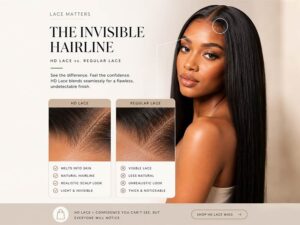
Los dos tipos de encaje que verás con más frecuencia en 2026 son encaje de alta definición (más delgado, más invisible, mas caro, mas delicado) y encaje transparente (durable, asequible, un poco más visible). Para la mayoría de las mujeres negras, un frente de encaje HD es el estándar de oro para una apariencia natural, mientras que el encaje transparente es la mejor opción para principiantes y para el uso diario.. Los encajes suizos y franceses son materiales de alta gama que se utilizan en unidades personalizadas y de lujo..
Cómo leer esta guía
Antes de entrar en cada tipo de encaje, Es útil comprender las dos preguntas que cada etiqueta intenta responder.:
- ¿De qué está hecho el encaje?? (Materiales — HD, transparente, suizo, Francés, coreano)
- ¿Cuánto de la peluca es de encaje?? (Construcción – cierre, frontal, 360, encaje completo)
Estas son dos cosas completamente diferentes., pero los vendedores a menudo los confunden. A “13×4 frente de encaje HD” les dice a ambos: la construcción es un frontal de encaje de 13×4, y el material es encaje HD. A “peluca de encaje completo suizo” te dice que es una peluca de cobertura total hecha con material de encaje suizo.
Esta guía se centra principalmente en material pregunta (HD frente a. transparente versus. suizo, etc.). Para un desglose de los estilos de construcción., consulte nuestra guía separada sobre estilos de pelucas de encaje.
El 5 Principales tipos de material de encaje
Casi todas las pelucas de encaje que se venden hoy en día utilizan uno de los cinco materiales de encaje.. Aquí está la disposición del terreno, en el orden en el que es más probable que los encuentres:
| Tipo de encaje | Visibilidad | Durabilidad | Nivel de precios | Mejor para |
|---|---|---|---|---|
| encaje de alta definición | Prácticamente invisible | Delicado | De primera calidad | aspecto natural, ocasiones especiales |
| Encaje transparente | Ligeramente visible | Durable | gama media | uso diario, principiantes |
| encaje suizo | Casi invisible | Frágil | De primera calidad / costumbre | Unidades de lujo, desgaste a largo plazo |
| encaje francés | Visible de cerca | Muy duradero | Presupuesto a mitad | Uso diario intenso, principiantes |
| encaje coreano | Visible | Muy duradero | Presupuesto | Traje, uso ocasional |
Ahora profundicemos en cada uno..
encaje de alta definición (Encaje de alta definición)
El encaje HD es el más fino., Los mejores encajes que se producen actualmente para la industria de las pelucas.. Es tan transparente que cuando se posa contra tu piel, esencialmente desaparece, no hay malla visible, sin borde obvio donde la peluca se encuentra con tu frente.
Este es el encaje que revolucionó el look natural. Hace cinco años, Incluso las mejores unidades tenían un frente de encaje visible a la luz del sol o debajo del flash de la cámara.. El encaje HD cerró esa brecha.
¿De qué está hecho realmente el encaje HD?
El encaje HD es una malla fina de nailon o poliéster., tejido con hilos ultrafinos, normalmente 30 denier o más delgado. El número de hilos por pulgada cuadrada es mucho mayor que el de otros cordones., Es por eso que cada hilo individual puede ser tan fino sin que el cordón se rompa en el manejo normal..
Profesionales del encaje HD
- Prácticamente invisible contra la piel. — funciona en una amplia gama de cutis con un tinte mínimo o nulo
- Fotografías bellamente — incluso con flash directo, la línea del cabello se lee natural
- Suave y cómodo — no pica ni pica en la línea del cabello
- El mejor material para líneas de cabello derretidas. — se mezcla tan bien que parece que el cabello crece en el cuero cabelludo
Contras del encaje HD
- Frágil — se rasga fácilmente si se arranca con demasiada agresividad o se tira con fuerza durante la instalación
- mas caro — el proceso de fabricación es más exigente
- Vida útil más corta con manejo brusco — los pequeños desgarros son difíciles de reparar
- Fácil de falsificar en marketing - muchos “encaje de alta definición” Las pelucas que se venden baratas son en realidad de encaje transparente.
El encaje Real HD tiene una sensación notablemente diferente al encaje transparente.. Cuando lo sostienes hacia la luz, apenas deberías ver el patrón de malla. Si puedes ver claramente la cuadrícula de hilos., eso es encaje transparente, no importa lo que diga la etiqueta. le decimos a la gente: si una peluca se vende como “encaje de alta definición” por debajo $150, Es casi seguro que el material del encaje se ha cambiado por transparente.. El coste de la materia prima hace que la verdadera HD sea imposible a ese precio..
¿Para quién es mejor el encaje HD?
- Usuarios de pelucas de encaje de nivel intermedio o experimentado que puedan manejar materiales delicados.
- Cualquiera que grabe contenido (tiktok, IG, sesiones de fotos) donde la línea del cabello se ve de cerca
- Mujeres con tonos de piel más profundos que desean un esfuerzo de tinte mínimo
- Ocasiones especiales, bodas, eventos
Encaje transparente
El encaje transparente es el caballo de batalla de la industria moderna de las pelucas de encaje.. Es el material de encaje con el que se construyen la mayoría de las pelucas del mercado masivo., y es lo que nuestro equipo recomienda para la mayoría de los principiantes..
El nombre es un poco engañoso: el encaje transparente en realidad no es incoloro.. Viene de fábrica pretintado en un color beige o melocotón muy claro., Diseñado para desaparecer en tonos de piel más claros.. Para tez más oscura, necesita tinte adicional antes de instalar, pero hace el trabajo de manera confiable.
¿De qué está hecho el encaje transparente?
El encaje transparente utiliza hilos de nailon o poliéster similares a los del encaje HD., pero los hilos son un poco más gruesos (típicamente 40-50 negador) y el patrón de malla es más visible de cerca. Esto hace que el material sea más duradero y más fácil de trabajar., pero ligeramente más visible contra la piel.
Profesionales del encaje transparente
- Más indulgente - maneja el desplumado, eliminación de pegamento, y se lava mejor que HD
- Asequible - normalmente $50-$150 Más barato que la peluca de encaje HD equivalente.
- Ampliamente disponible - todas las marcas importantes lo tienen en existencia
- Más fácil para principiantes — es menos probable que se rompa durante las primeras instalaciones
Contras del encaje transparente
- Necesita tinte en pieles más oscuras. — el tinte previo de fábrica es demasiado claro para pieles profundas
- Ligeramente visible de cerca - bien para el uso diario, menos ideal para fotografías de primeros planos extremos
- Puede verse gris contra la piel profunda si no está teñida
Si estás comprando tu primera peluca de encaje y no 100% Estoy seguro de cómo instalarlo todavía., conseguir encaje transparente. Los pocos minutos extra que dedicas a teñirlo con base valen la pena, ya que es un material que no se rompe cuando estás aprendiendo.. Guarde el encaje HD para cuando haya instalado al menos una unidad 5 veces y sabes exactamente lo que estás haciendo.
¿Para quién es mejor el encaje transparente?
- Compradores de pelucas de encaje por primera vez
- Cualquiera que lave y vuelva a instalar su peluca con frecuencia.
- Personas con un presupuesto limitado que aún quieren una unidad de calidad
- Usuarios diarios que necesitan durabilidad sobre perfección.
encaje suizo
El encaje suizo es el encaje de lujo original. Antes de que existiera el encaje HD, El encaje suizo era el estándar de oro para las unidades personalizadas de alta gama utilizadas por las celebridades., artistas escénicos, y mujeres que podían permitirse el lujo de trabajar con pelucas a medida.
Todavía se utiliza hoy en día en pedidos personalizados y unidades premium de encaje completo., pero lo verás con menos frecuencia en las pelucas delanteras de encaje del mercado masivo porque es caro y delicado..
¿De qué está hecho el encaje suizo?
El encaje suizo es una malla de nailon especial fabricada originalmente en Suiza. (de ahí el nombre), aunque gran parte de lo que ahora se vende como “encaje suizo” Se produce en China con especificaciones similares.. Los hilos son extremadamente finos y la malla es suave al tacto, casi como la seda..
Profesionales del encaje suizo
- Aspecto extremadamente natural — competitivo con encaje HD para la invisibilidad
- Suave y delicado con el cuero cabelludo sensible.
- Elección tradicional para unidades personalizadas premium
- De larga duración cuando se trata con suavidad
Contras del encaje suizo
- Frágil — desgarros debido a un arranque agresivo o una instalación brusca
- Caro - normalmente sólo se utiliza en $300+ unidades
- Menos disponible - las marcas más asequibles no lo tienen
- Mercado de especialidades — más difícil de encontrar en comparación con HD o transparente
¿Para quién es mejor el encaje suizo?
- Usuarios de pelucas a largo plazo que tratan sus unidades con cuidado.
- Compradores que solicitan unidades personalizadas o a medida
- Cualquier persona con cuero cabelludo sensible que necesite el material más suave posible.
- Mujeres que invierten en una peluca premium para uso diario
encaje francés
El encaje francés se encuentra en el otro extremo del espectro de durabilidad.. Es más fuerte y visible que el encaje suizo o HD., pero aguanta instalaciones repetidas, lava, y el manejo brusco mucho mejor.
Encontrarás encaje francés en muchas pelucas asequibles de gama media porque el costo es menor y el material es indulgente para los principiantes.. También es una opción común para pelucas teatrales o de disfraces donde la durabilidad importa más que la invisibilidad..
¿De qué está hecho el encaje francés?
El encaje francés usa más grueso., hilos más resistentes que el encaje suizo o HD, normalmente 60-80 denier: tejido con un patrón ligeramente más ajustado. El resultado es un encaje que resiste el desgarro pero que se lee más obviamente como “material de la peluca” contra la piel.
Profesionales del encaje francés
- Muy duradero — sobrevive a múltiples instalaciones y eliminaciones
- Asequible - común en $80-$250 pelucas
- Fácil para principiantes — mucho más difícil de romper que HD o Swiss
- Soporta la eliminación de pegamento y adhesivo. mejor que cordones más finos
Contras del encaje francés
- Visible de cerca — verás el patrón de malla con buena luz
- Parece menos natural en las fotos. — la fotografía con flash expone el encaje
- Más difícil de “derretir” en la línea del cabello - requiere más trabajo de maquillaje y tinte
¿Para quién es mejor el encaje francés?
- Principiantes aprendiendo a instalar
- Cualquier persona que use la misma unidad a diario y necesite la máxima durabilidad.
- Traje, teatral, o uso en escenario
- Compradores preocupados por su presupuesto y dispuestos a realizar un esfuerzo adicional en materia de tintes.
encaje coreano
El encaje coreano es el más básico., encaje duradero comúnmente utilizado en pelucas económicas. Es significativamente más grueso y más visible que los cuatro cordones de arriba., y se utiliza principalmente en pelucas sintéticas de nivel básico., piezas de vestuario, o pelucas diseñadas para uso muy ocasional.
Si buscas algo natural, rayita derretida, El encaje coreano no te llevará allí. Pero tiene su lugar..
¿De qué está hecho el encaje coreano?
El encaje coreano usa más grueso., fibras sintéticas más rígidas en una malla más densa. Es casi indestructible según los estándares del encaje., pero la desventaja es la visibilidad obvia: puedes ver claramente la malla en cualquier tono de piel..
Profesionales del encaje coreano
- Extremadamente duradero — soporta el uso rudo sin romperse
- Opción de encaje más barata
- Mantiene su forma Bueno
Contras del encaje coreano
- muy visible — no apto para líneas de cabello de aspecto natural
- Puede sentirse rígido o áspero
- No se utiliza en unidades premium
¿Para quién es mejor el encaje coreano?
- Pelucas de Halloween o de disfraces.
- Actuación escénica bajo mucho maquillaje.
- Uso muy ocasional donde el precio importa más que el realismo.
encaje HD vs.. Encaje transparente: La comparación más común
Esta es la comparación por la que más nos preguntan que por cualquier otra, entonces merece su propia sección. La mayoría de los compradores eligen entre encaje HD y transparente., y la decisión se reduce a cuatro factores: tono de piel, experiencia de instalación, presupuesto, y caso de uso.
| Factor | encaje de alta definición | Encaje transparente |
|---|---|---|
| Invisibilidad en la piel | Casi invisible en todos los tonos de piel. | Visible de cerca, especialmente en la piel más profunda |
| Durabilidad | Delicado: lágrimas bajo estrés | Robusto: soporta el uso repetido |
| Se requiere tintado | Mínimo en la mayoría de los tonos de piel. | Requerido en piel media a profunda. |
| diferencia de precio | Apenas 30-50% mas caro | Más asequible |
| Mejor nivel de habilidad | Intermedio a avanzado | Apto para principiantes |
| Compatible con fotos y vídeos | Excelente | Bueno con el tinte adecuado. |
Aquí hay un pequeño detalle que la mayoría de los blogs no mencionan.: El encaje HD y el encaje transparente suelen fabricarse en las mismas fábricas., a veces en líneas de producción adyacentes. La diferencia de costo entre los dos no es solo el material, sino el rendimiento de la producción.. El encaje HD tiene una mayor tasa de rechazo durante la fabricación porque los hilos finos son más fáciles de dañar.. Una fábrica podría tirar 15-20% de encaje HD como defectuoso vs.. 5% para transparente. Esa tasa de desperdicio es lo que realmente impulsa la brecha de precios., más que el costo mismo de la materia prima.
Encaje preblanqueado y predesplumado: Lo que estos añaden
“Pre-blanqueado” y “pre-arrancado” No son tipos de encaje separados: son opciones de procesamiento que se pueden aplicar a cualquiera de los materiales anteriores..
Nudos preblanqueados
En una peluca de encaje estándar, el cabello está atado al encaje con pequeños nudos oscuros que son visibles en las raíces; parecen pequeños puntos oscuros esparcidos por el encaje, que delata la peluca “falsedad” de cerca. Decolorar esos nudos los aclara para que se mezclen con el encaje y desaparezcan en tu cuero cabelludo..
Preblanqueado significa que la fábrica hizo este trabajo antes del envío.. el beneficio: Raíces instantáneas de aspecto natural sin tener que manipular lejía.. El inconveniente: la lejía debilita el cabello en el nudo, lo que puede provocar que se caiga con el tiempo.
Línea del cabello pre-arrancada
Fuera de la fábrica, la mayoría de las pelucas de encaje tienen una línea de cabello que parece “demasiado perfecto” — uniformemente denso de borde a borde, como una sólida pared de cabello. Pre-arrancado significa que la fábrica ha adelgazado la línea del cabello a mano., eliminar mechones en un patrón que imita el crecimiento natural del cabello.
Este es uno de los factores más importantes para que una peluca luzca natural nada más sacarla de la caja.. Una peluca bien depilada de una fábrica de calidad te salva 30+ Minutos de cuidadoso desplume manual antes de su primera instalación..
La calidad pre-desplumada varía enormemente entre fábricas.. Barato “pre-arrancado” Las pelucas a menudo solo tienen cabello adelgazado agresivamente en todo el frente., que parece más escaso que natural. Un buen pre-desplumado es desigual por diseño: más denso en algunas áreas, más escaso en otros, imitando cómo crece el cabello real. cuando estas de compras, Mire de cerca las fotos de densidad del cabello.. Si se ve perfectamente parejo, el “pre-desplumado” no se hizo bien.
¿Qué pasa con “Top de seda coreano” o “Base de seda” Pelucas?
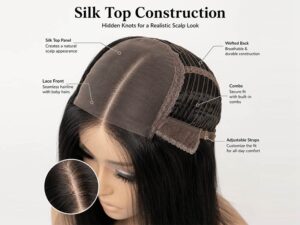
Es posible que encuentres listados de “top de seda” o “base de seda” pelucas. En realidad, estos no son encajes, son una construcción de gorra completamente diferente..
Una peluca con parte superior de seda tiene un pequeño parche de tela de seda en la coronilla., con el cabello inyectado en la seda para que los nudos queden ocultos debajo. El resultado es una mirada hiperrealista del cuero cabelludo a la pieza.. El resto de la peluca todavía puede usar encaje., pero el parche de seda crea el más realista. “de despedida” puedes conseguir.
- Ventajas: El cuero cabelludo más natural mira la pieza., no hay nudos visibles
- Contras: más caliente de usar, mas caro, área de peinado más pequeña en la parte
- Lo mejor para: pelucas donde la raya es el punto focal, mujeres maduras que quieren raíces grises realistas
Cómo saber qué tipo de encaje tiene realmente una peluca
Las marcas no siempre son honestas sobre el tipo de encaje. Así es como nuestro equipo verifica lo que realmente estás obteniendo:
- Mira el encaje bajo luz directa.. Sostenga el cordón contra una ventana o una lámpara brillante.. El encaje HD debe ser apenas visible, casi como una película transparente.. Si puedes ver claramente la rejilla de malla., es transparente o más grueso.
- Toca el encaje. HD y encaje suizo se sienten suaves, casi sedoso. El encaje francés y coreano se siente ligeramente más rígido y texturizado..
- Consulta el precio. Una peluca frontal de encaje HD genuina con buen cabello humano comienza $200-$250. Si se vende como encaje HD por menos de eso, Es probable que el material del encaje haya sido cambiado..
- Pide una foto en primer plano del encaje en un dedo.. Un vendedor de buena reputación enviará esto.. El encaje HD se combinará con el tono de piel del dedo.; los cordones más gruesos se mostrarán como un parche visible.
- Lea las especificaciones del material real.. Algunas marcas honestas enumeran el denier o el número de hilos.. denier más bajo (bajo 40) significa más delgado, encaje más invisible.
Cómo combinar el tipo de encaje con el tono de piel
Esta parte es especialmente importante para las mujeres negras., porque los materiales de encaje originales de la industria fueron diseñados para tez más clara. Aquí está la guía sencilla de nuestro equipo:
| Tono de piel | Encaje recomendado | Notas de tinte |
|---|---|---|
| Luz / justo | Encaje transparente o HD, sin teñir | Por lo general, no es necesario teñir |
| Marrón claro a medio | Encaje transparente con tinte claro. | Base o BB cream es suficiente |
| Marrón medio a intenso | Encaje HD o transparente pretintado | Varias capas de base, o tinte para tela |
| Profundo al ébano | encaje de alta definición, pre-tintado por la fábrica | Compre de marcas que ofrezcan unidades pretintadas |
Para tonos de piel más profundos, Recomendamos encarecidamente elegir una marca que ofrezca encaje HD pretintado como opción sobre acciones. Teñir el encaje usted mismo con trabajos de base, pero nunca es tan limpio como el tinte de fábrica, y el maquillaje puede pegarse a la ropa o a la almohada.
¿Cuánto debería pagar por cada tipo de encaje??
El precio varía según la marca., calidad del cabello, y construcción. Pero nuestro equipo puede brindarle cifras aproximadas confiables para pelucas delanteras de encaje de cabello humano. (13×4 o 13×6, 18-20 pulgadas) basado en lo que vemos en el mercado:
| Tipo de encaje | Rango de presupuesto | Gama de calidad | Gama Premium |
|---|---|---|---|
| encaje coreano | $30-$80 | $80-$150 | Rara vez premium |
| encaje francés | $80-$150 | $150-$300 | $300+ |
| Encaje transparente | $100-$180 | $180-$350 | $350+ |
| encaje de alta definición | $180-$280 | $280-$500 | $500-$1,000+ |
| encaje suizo | Rara vez presupuesto | $300-$600 | $600-$1,500+ (costumbre) |
Debajo del “presupuesto” columna para cualquier tipo de encaje, Es casi seguro que obtendrás cabello sintético., cabello no remy, o un material que no coincide con la etiqueta.
Si lees solo esta sección, aquí está todo lo que necesitas saber:
- Si eres principiante: Compra un frente de encaje transparente de 13×4, $180-$280 rango, en 150% o 180% densidad. Practica en esto. Aprenderás lo que te gusta.
- Si estás listo para actualizar: Pase a HD Lace una vez que haya instalado su unidad para principiantes 5+ veces sin desgarros. El aspecto natural es un salto notable..
- Si tienes la piel más profunda: Priorice siempre el encaje HD o el encaje pretintado. El trabajo de teñido en encaje transparente se vuelve agotador después de un tiempo., y fotografías en HD mejores.
- Si lo usas a diario durante muchas horas.: El encaje francés es realmente mejor en términos de durabilidad si puedes aceptar una línea del cabello menos invisible.. No lo descartes sólo porque es “nivel inferior.”
- Si está invirtiendo en una unidad a largo plazo: Una peluca de encaje completo suizo personalizada es el estándar de oro, pero espera gastar $700+.
El material del encaje es sólo un factor para que una peluca luzca natural. Incluso el mejor encaje HD parecerá falso si no está teñido, la línea del cabello no está arrancada correctamente, o la gorra no es del tamaño adecuado para tu cabeza. No te obsesiones con conseguir el “mejor” encaje: concéntrate en conseguir el encaje adecuado para tu piel, tu nivel de habilidad, y tu estilo de vida. La línea del cabello más invisible es la que realmente está instalada correctamente..
Preguntas frecuentes
¿Realmente vale la pena el dinero extra del encaje HD??
Para la mayoría de las mujeres negras, Sí, especialmente si tienes un tono de piel medio a profundo o tomas fotos y vídeos con regularidad.. El aspecto natural del encaje HD es una clara mejora del encaje transparente.. Para usuarios ocasionales o principiantes que rasgan el encaje con facilidad., El encaje transparente es un punto de partida más inteligente..
¿Cuál es la diferencia entre encaje HD y “encaje HD pretintado”?
El encaje HD estándar viene en un beige claro neutro.. El encaje HD pretintado se ha teñido de un tono más oscuro en la fábrica para combinar con tonos de piel medios a profundos., para que no tengas que teñirlo tú mismo antes de instalarlo. Si tienes la piel más profunda, Vale la pena pagar más por el pretintado..
¿Puedo blanquear yo mismo los nudos del encaje HD??
Puede, pero es arriesgado. El encaje HD es delicado, y el blanqueamiento agresivo puede debilitarlo o rasgarlo.. Si quieres nudos blanqueados en encaje HD, La recomendación de nuestro equipo es pedir una peluca que venga preblanqueada de fábrica; el proceso controlado a escala tiende a ser más seguro que el blanqueamiento hecho por usted mismo..
¿Por qué mi peluca de encaje HD todavía parece obvia??
Generalmente una de tres razones: (1) El encaje no estaba teñido para combinar con tu piel., (2) no te arrancaste la línea del cabello lo suficiente, o (3) En realidad no es encaje HD a pesar de la etiqueta.. Sostenga el cordón hacia la luz, si ve una rejilla de malla transparente., tienes encaje transparente. Cubrimos esto en detalle en nuestro “¿Por qué mi peluca de encaje parece falsa??” guía.
¿Cuánto dura el encaje HD vs.. encaje transparente?
Con un manejo cuidadoso, una peluca de encaje HD de cabello humano dura aproximadamente tanto como una transparente. 1 a 2 años. Pero es más probable que el encaje HD desarrolle pequeños desgarros en la línea del cabello con el tiempo., especialmente si quitas el adhesivo de forma agresiva. El encaje transparente tiende a durar más en la práctica porque tolera mejor el trato brusco..
¿Es el encaje suizo mejor que el encaje HD??
En realidad no es mejor ni peor: son materiales diferentes con casos de uso superpuestos.. El encaje HD está diseñado para ser el encaje más invisible del mercado masivo.; El encaje suizo es un material de lujo tradicional apreciado por su suavidad y aspecto natural.. Para la mayoría de los compradores modernos, El encaje HD te da 95% de la mirada a un precio más accesible.
¿Puedo usar encaje HD para una peluca de encaje completo??
Sí, pero es cara: una peluca de encaje Full HD suele empezar alrededor $500 y va mucho más alto para cabello premium. El beneficio es la peluca con el aspecto más natural posible., con encaje invisible que cubre toda la gorra. El inconveniente es la fragilidad: cuanto mayor es el área del cordón, mayor riesgo de pequeños desgarros con el tiempo.
Continuar aprendiendo
Si has llegado hasta aquí, aquí es donde nuestro equipo recomienda ir a continuación:
- [Enlace interno al Blog #1] La guía completa de pelucas de encaje: para obtener una descripción general completa para principiantes
- [Enlace interno al Blog #4] Encaje HD versus encaje transparente: ¿Cuál realmente desaparece en tu piel??
- [Enlace interno al Blog #7] Frente de encaje versus encaje completo versus 360 Cordón: Comparación completa
- [Enlace interno al Blog #19] Qué buscar al comprar su primera peluca de encaje: Una lista de verificación para expertos de la fábrica
- [Enlace interno al Blog #20] Guía de densidad de pelucas de encaje: 130%, 150%, 180%