
One of the most confusing parts of buying your first lace wig is decoding the numbers in the product name. 13×4. 13×6. 5×5. 4×4. 6×6. These dimensions tell you exactly how big the lace area is — but most product listings never bother to explain what that actually means for how the wig looks or how you can style it.
Our team gets this question every week: “What’s the difference between 13×4 and 13×6, and which should I buy?”
This guide walks through what each size means, who it’s best for, what it costs more or less, and the trade-offs no one tells you about. By the end, you’ll know exactly which size matches your styling needs, face shape, and budget.
What the Numbers Actually Mean
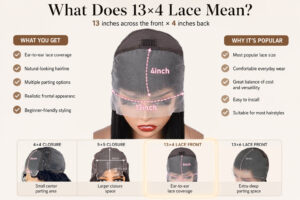
Each pair of numbers describes the dimensions of the lace patch on the wig, in inches.
- The first number = the width (left to right across your forehead)
- The second number = the depth (how far back the lace extends from the front edge)
So a 13×4 lace front has 13 inches of lace running across the front of the wig, and that lace extends 4 inches back toward the crown. A 5×5 closure has a 5-inch by 5-inch square of lace on the top of the wig — and only that area is lace. The rest is machine-wefted hair.
The Main Lace Sizes Explained
13×4 Lace Frontal
The most popular lace wig size on the market today. The 13-inch width covers your entire front hairline from ear to ear, and the 4-inch depth gives you enough lace to part anywhere across the front of the wig.
Best for: Side parts, middle parts, slight angle parts, pulled-back styles where some of the front is exposed.
Limitations: Can’t do deep side parts or pull all hair back into a high ponytail without exposing the wig cap behind the lace.
13×6 Lace Frontal
Same width as a 13×4 (13 inches across the front), but the lace extends 6 inches back instead of 4. The extra 2 inches of depth opens up more styling options, especially for deeper parts.
Best for: Deep side parts, dramatic middle parts, half-up styles where the parting area shows, slick-back looks.
Limitations: More expensive than 13×4 (usually $40-80 more). The extra lace area is also more fragile and harder to install evenly.
5×5 Lace Closure
A 5-inch by 5-inch square of lace on the top of the wig, typically positioned at the crown. The rest of the wig is machine-wefted hair, which makes it the most budget-friendly option.
Best for: Middle-part styles, simple ponytails behind the closure, beginners who don’t need extensive styling versatility.
Limitations: No real hairline — your natural edges have to be left out and blended with the wig. Cannot do side parts or pulled-back styles.
4×4 Lace Closure
The smaller version of 5×5. Same concept, but with a 4-inch by 4-inch lace patch. Less expensive but offers even less styling flexibility.
Best for: Strict middle-part styles only, budget buyers.
Limitations: Even more restricted parting area. Hard to style anything other than a straight middle part.
6×6 Lace Closure
A larger closure that gives you a bit more parting freedom than 5×5, but still no front hairline.
Best for: Slightly off-center middle parts, shallow side parts within the closure area.
Limitations: Still no real hairline — you’re relying on your own edges and the wig blend.
Side-by-Side Comparison
| Size | Lace Coverage | Parting Versatility | Hairline? | Price Range |
|---|---|---|---|---|
| 4×4 Closure | 4″ × 4″ square top | Middle part only | No | $60-$120 |
| 5×5 Closure | 5″ × 5″ square top | Middle part + slight side | No | $80-$180 |
| 6×6 Closure | 6″ × 6″ square top | Middle + shallow side | No | $120-$220 |
| 13×4 Frontal | 13″ × 4″ front | Any part along front | Yes | $120-$300 |
| 13×6 Frontal | 13″ × 6″ front | Deep parts, half-up | Yes | $160-$380 |
Closure vs Frontal: The Big Difference
Before going further, it helps to understand the fundamental difference between a closure and a frontal.
Closures
Closures are smaller patches of lace placed on top of the wig, usually 4×4, 5×5, or 6×6 inches. They don’t extend to your hairline. To wear a closure wig, you typically leave out your own front hairline and edges, and blend them with the wig.
Pros: Cheaper, gentler on the hairline (less adhesive needed), faster install.
Cons: Requires having natural edges and a hairline that can blend, no styling versatility at the front.
Frontals
Frontals are larger lace pieces (typically 13×4 or 13×6) that cover your entire front hairline from ear to ear. They replace your natural hairline visually, so all your edges are covered by the wig.
Pros: Real-looking hairline, full versatility, can pull hair back without exposing the cap, works for women with damaged or thinning edges.
Cons: More expensive, more install work, more potential for hairline damage if installed roughly.
your edges are thin, damaged, or you’ve struggled with hair loss at the front, our team strongly recommends a frontal (13×4 or 13×6) over a closure. Trying to blend a closure with damaged edges often makes the damage more obvious. A frontal covers everything and gives you a clean, controlled hairline regardless of what’s underneath.
13×4 vs 13×6: The Most Common Comparison
Once you’ve decided you want a frontal (not a closure), the next question is 13×4 or 13×6. Here’s the honest breakdown:
Choose 13×4 if:
- You usually wear middle parts or shallow side parts
- You want a more affordable option
- You’re a beginner (smaller lace area is easier to install)
- You don’t typically pull your hair back into half-up styles
- This is your first or second lace wig
Choose 13×6 if:
- You love deep side parts
- You want to do half-up half-down styles where the parting shows
- You frequently slick back the front of your hair
- You shoot a lot of content where the part area is visible
- You’re an experienced wearer comfortable installing larger lace
What About 13×7 or Bigger?
You’ll occasionally see 13×7 or even 13×8 frontals advertised. These exist for stylists and content creators who want maximum parting depth, but our team’s honest take is that for everyday wearers, they’re not worth the extra cost. The styling difference between 13×6 and 13×7 is barely noticeable, and the fragility increases significantly.
If you want even more versatility than 13×6, the better upgrade is to a 360 lace wig (lace runs the full perimeter of the wig, allowing ponytails) or a full lace wig (the entire cap is lace, allowing any style).
Which Size Is Best for Your Face Shape?
This is a question our stylist team thinks about often. The lace size doesn’t change your face shape directly, but the styling options each size allows can flatter or work against your features.
| Face Shape | Recommended Size | Why |
|---|---|---|
| Round face | 13×6 | Deep side parts add length and angle, slimming the face |
| Oval face | 13×4 or 13×6 | Works with almost any parting style |
| Square face | 13×6 | Side parts soften angular features |
| Heart-shaped face | 13×4 with middle part | Balances a wider forehead |
| Long face | 13×4 with bangs option | Shorter parting area helps reduce length |
How Lace Size Affects Price
Generally, bigger lace = higher price. The reasons:
- More raw material — bigger lace pieces use more lace
- More hand-ventilation labor — each strand is hand-tied, and bigger lace areas mean more hours of work
- Higher rejection rate — bigger lace areas mean more places where defects can occur, so more units get rejected
Here’s a rough rule of thumb our team uses for human hair lace wigs:
- 13×6 typically costs 30-50% more than 13×4 of the same brand and hair quality
- 13×4 frontal typically costs 40-80% more than a 5×5 closure
- 360 lace typically costs 50-100% more than 13×6
Buying Recommendation
If you’re standing in front of two options and can’t decide, here’s what we’d tell you based on the most common situations:
First lace wig ever
Get a 13×4. It’s the most versatile entry point, easier to install than 13×6, and the price gap from a closure is worth it for the real hairline.
Upgrading from a closure to a frontal
Start with 13×4. The styling jump from closure to frontal is already huge. Try 13×6 on your second or third frontal once you’ve mastered the install.
Building a wig collection
Mix sizes. Have a 13×4 for everyday wear, a 13×6 for events and content, and a closure unit for budget days when you want a quick swap.
Budget-conscious
5×5 closure if you only wear middle parts. 13×4 frontal if you can stretch the budget — it’s a much bigger jump in look and versatility.
Content creator
13×6 minimum. The extra parting depth gives you more shot variety, and the deeper lace handles close-ups better.
Frequently Asked Questions
What’s the difference between 13×4 and 4×4?
A 13×4 is a frontal that covers your entire front hairline (13 inches across, 4 inches deep). A 4×4 is a small closure (just 4 inches by 4 inches on the top of the wig) with no hairline coverage. Completely different products at very different price points.
Is 13×6 really worth the extra money over 13×4?
For specific use cases — deep side parts, content creation, half-up styles — yes. For everyday wear with simple parts, no. Most Black women do perfectly well with 13×4 and could spend the price difference on better hair quality instead.
Can I cut down a 13×6 to fit like a 13×4?
You can cut the extra lace at the back of a 13×6, but you’re paying for lace you’re not using. The hand-ventilation at the back of the 13×6 is what costs more — cutting it off afterward doesn’t recover that cost. Just buy 13×4 if that’s what you need.
What lace size do most influencers use?
Most popular Black wig influencers use 13×6 because they create content. The deeper part area gives them more styling shots. But this doesn’t mean it’s the right size for everyday wear — content creator needs are different from regular daily use.
Is a 6×6 closure better than a 13×4 frontal?
Different products. A 6×6 closure is a top-of-wig piece with no hairline, while a 13×4 frontal covers the full front hairline. Most women find 13×4 frontals more useful long-term, but a 6×6 closure is cheaper and easier to install if you only need middle parts.
Do bigger lace sizes look more natural?
Not directly. What makes a wig look natural is the hairline plucking, lace tinting, and install quality. A well-prepped 13×4 looks more natural than a poorly-prepped 13×6. Bigger lace just gives you more parting freedom, not more realism.
Continue Learning
- [Internal link to Blog #1] The Complete Guide to Lace Wigs
- [Internal link to Blog #2] Lace Wig Types Explained: HD vs Transparent vs Swiss
- [Internal link to Blog #7] Lace Front vs Full Lace vs 360 Lace: Complete Comparison
- [Internal link to Blog #19] What to Look for When Buying Your First Lace Wig
- [Internal link to Blog #3] How to Install a Lace Wig: Step-by-Step Guide