
Quick Answer
Kinky straight usually looks the most like blown-out natural hair. Yaki straight often looks like relaxed or silk-pressed hair. Silky straight looks the smoothest and shiniest, but it may appear less natural if you want a textured everyday look. The best choice depends on your natural hair texture, desired volume, styling habits, and how polished you want the wig to look.
Why Texture Matters
When people choose a wig, they often focus on lace, comprimento, densidade, and cap construction. Texture can matter just as much.
The same wig length can look completely different depending on texture. A 20-inch silky straight wig may look sleek and flat. A 20-inch kinky straight wig may look fuller, thicker, and closer to a blowout. A yaki straight wig may sit somewhere in between.
Texture affects natural appearance, maintenance, movement, and how easily the wig blends with leave-out or edges.
This is why the question is not only “Which texture is best?” It is “Which texture looks natural for the style you want?”
What Is Kinky Straight?
Kinky straight hair is designed to mimic natural textured hair that has been stretched, blown out, or lightly pressed. It usually has more body, texture, and fullness than silky straight hair.
The strands may have a slightly coarse feel or a soft crimped pattern. The overall look is straight, but not bone-straight.
Kinky straight can be a good choice if you want a wig that looks like natural hair after a blowout. It can also look more realistic with textured edges or natural leave-out because the finish is not too smooth.
The main trade-off is volume. Kinky straight hair can feel fuller, and some users may need to flat iron or style it to reduce bulk.

What Is Yaki Straight?
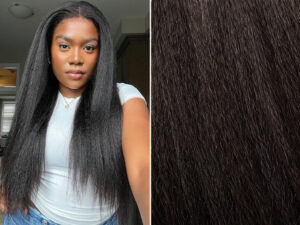
Yaki straight hair is usually made to resemble relaxed, pressed, or lightly textured straight hair. It is smoother than kinky straight but not as sleek as silky straight.
For many Black women, yaki straight is a comfortable middle ground. It has enough texture to avoid looking overly shiny or synthetic, but it still gives a polished straight look.
Yaki straight can work well for daily wear, professional styles, and natural-looking straight looks. It often has less volume than kinky straight, which can make it easier to manage.
The exact look varies by seller. Some yaki textures are very light and close to silky straight. Others have a more visible texture.
What Is Silky Straight?
Silky straight hair is smooth, sleek, and often shinier than kinky or yaki textures. It is the classic polished straight wig look.
This texture can look elegant and clean, especially for middle parts, side parts, long layers, and sleek styles. It may also be easier to brush and style if the hair quality is good.
The downside is that silky straight may not always look like natural textured hair. If the density is high, the shine is strong, or the hairline is too perfect, the wig can look less realistic for everyday wear.
Silky straight is not bad. It just gives a different effect.
Which Looks Most Natural?
For a blown-out natural look, kinky straight usually wins.
For a relaxed or silk-pressed natural look, yaki straight is often the most balanced.
For a sleek salon look, silky straight may be the best choice.
Natural appearance depends on more than texture, though. Density, cor de renda, parting, linha do cabelo, comprimento, and styling all matter. A well-installed silky straight wig can look natural. A poorly fitted kinky straight wig can still look obvious.
Texture helps, but it does not do all the work.
Volume and Density Differences
Kinky straight often looks fuller at the same density. UM 150% kinky straight wig can appear thicker than a 150% silky straight wig because the texture creates more body.
Yaki straight usually has moderate fullness. It can look natural without becoming too bulky.
Silky straight tends to lie flatter. Some users like that because it feels sleek. Others may feel it lacks body unless styled with layers or volume.
When choosing density, consider texture. You may not need very high density in kinky straight if you want a natural daily look.
Maintenance Differences
Kinky straight may need more detangling and moisture because textured hair can catch more easily. It may also react more visibly to humidity and friction.
Yaki straight is usually easier to maintain than kinky straight while still giving a textured look. It may need light heat styling to keep the finish neat.
Silky straight is often the easiest to brush, but it can show oil, product buildup, and heat damage more clearly. If the hair is low quality, silky straight can also become stringy over time.
No texture is maintenance-free. The right choice is the one that fits your routine.
Blending with Natural Hair
If you plan to leave out some natural hair, texture becomes even more important.
Kinky straight blends better with blown-out natural hair. Yaki straight blends better with relaxed or pressed hair. Silky straight may require your leave-out to be very smooth to match.
For lace wigs with no leave-out, blending is more about the hairline and lace. Still, texture affects whether the overall style looks believable on you.
If your natural hair has texture and you want a realistic everyday look, kinky or yaki straight may feel more natural than silky straight.
Who Should Choose Kinky Straight?
Choose kinky straight if you like fullness, texture, and a blowout look. It is a strong option for natural-looking everyday styles, especially if you want the wig to mimic textured hair.
It may not be best if you dislike volume or want a very sleek finish with minimal styling.
Who Should Choose Yaki Straight?
Choose yaki straight if you want a polished but still natural-looking texture. It works well if you want something less bulky than kinky straight but less shiny than silky straight.
This is often the safest middle choice for realistic straight styles.
Who Should Choose Silky Straight?
Choose silky straight if you want a sleek, smooth, high-polish look. It works well for clean parts, long straight styles, and elegant styling.
It may not be the most natural choice if you want the wig to look like blown-out textured hair.
What to Check Before Buying
Before buying, check real photos and videos, not only product names.
Look at how much texture is visible, how shiny the hair looks, how full the wig appears, and whether the density matches your goal. Check whether the texture stays after washing. Read reviews that mention tangling, shedding, and whether the wig looks like the photos.
Texture names are not always consistent across sellers, so visuals matter.
Final Verdict
Kinky straight, yaki straight, and silky straight can all look natural in the right context.
Kinky straight is best for a blown-out natural look. Yaki straight is best for a relaxed, pressed, everyday natural look. Silky straight is best for a sleek and polished style.
The most natural choice is the one that matches your real-life styling goal, not just the one that looks best in product photos.
If you are unsure, yaki straight is often the most balanced starting point.
Perguntas frequentes
Is kinky straight more natural than silky straight?
It can look more natural if you want a blown-out textured look. Silky straight looks smoother and more polished but may not mimic natural textured hair.
What is the difference between kinky straight and yaki straight?
Kinky straight usually has more texture and volume. Yaki straight is smoother and often resembles relaxed or pressed hair.
Is yaki straight good for everyday wear?
Sim. Yaki straight is often a good everyday texture because it looks polished while keeping some natural texture.
Does silky straight look fake?
Not always. Silky straight can look beautiful and natural with the right density, lace, and styling. It may look less realistic if it is too shiny or too dense.
Which texture is easiest to maintain?
Silky straight is often easiest to brush, but yaki straight can be the best balance of natural look and manageable care.
Continuar aprendendo
From here, we recommends these next:
- [Link interno para o blog ]O guia completo para perucas de renda
- [Link interno para o blog ]Como instalar uma peruca de renda: O guia passo a passo definitivo (2026)
- [Link interno para o blog ]Guia de densidade de peruca de renda: 130%, 150%, 180% – Qual densidade é certa para você?
- [Link interno para o blog ]O que é uma peruca de renda? Um guia para iniciantes (2026)