
Quick Answer
A lace front wig should sit where your natural hairline would visually begin. For most people, that means the lace edge sits close to the natural hairline, while the wig hairline follows the shape of the forehead and temples.
If the wig is too far down, your forehead may look short and the lace edge may look heavy. If it is too far back, your natural hair, wig cap, or thinning front area may show. The goal is not to hide your entire forehead. The goal is to create a believable hairline position.
What Does Natural Wig Placement Mean?
Natural placement means the wig looks like it belongs to your face shape. It should not sit in the same place for every person. A low forehead, high forehead, widow’s peak, deep temples, or receding hairline can all change where the wig looks most realistic.
The wig should also feel comfortable. If you need to pull the wig forward so hard that the nape rises or the temples stretch, the problem may be cap fit, not placement.
Why Placement Matters So Much
Even a high-quality lace front can look fake if it sits in the wrong place. The hairline controls facial proportion. When it is too low, the face can look compressed. When it is too high, the wig can look like it is sliding back.
Placement also affects security. A wig positioned incorrectly may lift at the temples, expose the wig cap, or create tension at the front. Before adding adhesive, check whether the wig is simply sitting in the wrong spot.
The Three-Point Placement Check
1. Center Forehead Point
Start by placing the center of the wig hairline near your natural center hairline. If you still have natural hair, do not force the wig far over your edges. Smooth your natural hair back first, then position the lace so it covers the transition without crushing the hairline.
If you do not have a visible natural hairline, use your face proportion. The wig should not sit so low that your eyebrows and hairline look crowded.
2. Temple Area
The temple area is where placement mistakes show quickly. If the wig is too far forward, the temples may look boxed in or thick. If it is too far back, your natural hair or wig cap may peek through.
Both sides do not have to be perfectly identical, because real hairlines are not always symmetrical. But the placement should feel balanced.
3. Ear Tabs
Ear tabs should sit near the sides of your face without covering your ears or pulling upward. If the ear tabs are too far forward or too far back, the whole wig may be misaligned.
Do not use the front hairline alone as your guide. Check the ear tabs before securing the wig.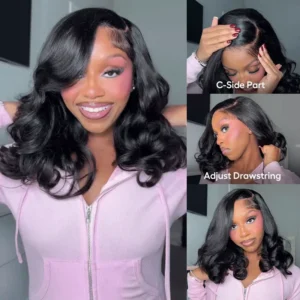
Signs the Wig Is Sitting Too Far Down
The wig may be too far down if your forehead looks much shorter than usual, the lace edge sits close to your eyebrows, or the front hairline looks like a hard helmet edge.
Other signs include:
- Ear tabs covering part of your ears
- Baby hairs sitting too low on the forehead
- Lace buckling because it is pushed onto curved skin
- The nape riding up when you pull the front down
- The style making your face look crowded
If this happens, move the wig back slightly and check again in natural light.
Signs the Wig Is Sitting Too Far Back
The wig may be too far back if your natural hairline, wig cap, stocking cap, or thinning front area shows in front of the lace.
You may also notice the lace pulling at the front, the part starting too far back, or the temples looking exposed. If the wig keeps sliding backward, check cap size and band tension.
Placement With Natural Hair
If you have natural hair at the front, protect it first. Your wig should not be pulled tightly over fragile edges. Smooth the hair back gently and avoid bulky braids or caps near the hairline.
If your natural hairline is lower than the wig hairline, you may need a different parting style, a wig cap closer to your skin tone, or a wig with a better hairline shape. Do not keep lowering the wig until the forehead looks unnatural.
Placement With Thinning Hair or Hair Loss
If you have thinning hair, the goal is coverage without tension. The wig can sit slightly in front of the thinning area, but it should still look like a natural hairline.
Avoid tight bands or combs directly on fragile edges. If the wig only looks secure when pulled very low, the cap may not fit correctly.
Placement for Different Forehead Shapes
For a smaller forehead, the wig may need to sit a little higher to avoid crowding the face. For a higher forehead, the wig may sit slightly lower, but it should still look proportional.
For deep temples, focus on the side shape. A center placement can look correct while the temples still look exposed. In that case, you may need a lace front with better temple coverage or a style that softens the side hairline.
Side-by-Side Placement Guide
| Placement | What It Looks Like | What to Do |
|---|---|---|
| Too far down | Short forehead, heavy edge, low baby hairs | Move wig back and reset ear tabs |
| Too far back | Natural hair or cap shows | Move wig forward slightly or adjust base |
| Uneven | One temple higher or lower | Re-center from ear tabs |
| Too tight | Front pulls backward or hurts | Loosen band or check cap size |
| Natural | Forehead proportion looks balanced | Secure lightly and style |
What Sellers May Not Explain
Product photos often show the wig placed on a model or mannequin with a different forehead shape from yours. That does not guarantee the same placement will work on you.
Also, pre-cut lace gives less room to adjust. If the lace edge has already been shaped, you may need to position the wig more precisely than with uncut lace.
Glueless wigs still need correct placement. A secure cap cannot make a badly positioned hairline look natural.
What to Check Before Securing the Wig
- Check the center forehead point first.
- Align both ear tabs before judging the front.
- Make sure natural hair is flat and protected.
- Look at the temples in natural light.
- Check whether the forehead proportion looks like you.
- Adjust straps before adding glue or spray.
- Do not cut more lace until placement is correct.
- Take a quick front and side photo before finalizing.
Final Verdict
A lace front wig should sit where the hairline looks natural for your face, not at a fixed distance on every person. If it is too low, the wig can look heavy and artificial. If it is too high, your hair or cap may show.
Use the center point, temples, and ear tabs together. Once those three areas line up, the lace, part, and styling usually become much easier to judge.
FAQ
Should a lace front cover my natural hairline?
It can sit slightly in front of your natural hairline, but it should not be pulled so far forward that it covers too much forehead or creates tension on your edges.
How do I know if my wig is too far forward?
Your forehead may look unusually short, the lace may buckle, or the baby hairs may sit too close to your eyebrows.
Why does my wig show my real hairline?
The wig may be too far back, the cap may be too small, or your natural hair may not be flat enough under the wig.
Should I place the wig before cutting lace?
Yes. Always test placement before cutting lace. Once lace is cut, you have less room to adjust the shape.
Can a glueless wig sit farther back?
Only if the hairline still looks natural and your natural hair or cap does not show. Glueless does not change the basic placement rules.